What is the Five Eyes intelligence alliance?
The Five Eyes intelligence alliance (FVEY for short) is an intelligence-sharing partnership between five countries: Australia, Canada, New Zealand, the United Kingdom, and the United States. It’s the world’s oldest and most established intelligence-sharing partnership. It’s built on the UKUSA Agreement — a post-WWII treaty that set up formal cooperation on signals intelligence (SIGINT).
The Five Eyes alliance allows its member countries to swap intelligence gathered by their national intelligence agencies. While signals intelligence remains the foundation of the partnership, today it also covers areas like cybersecurity, counterterrorism, counterintelligence, human intelligence, and geospatial intelligence. According to the UK and US governments, this long-standing cooperation helps member countries respond more effectively to shared security threats.
The alliance took its name from a classification stamp: “AUS/CAN/NZ/UK/US EYES ONLY.” That label marked documents that only the five partner governments could access. Over time, “Five Eyes” became the common shorthand for both the partnership and the arrangements built on the UKUSA Agreement.
Five Eyes may be the best-known intelligence alliance, but it isn’t the only one. Larger groups, like the Nine Eyes and Fourteen Eyes, include more countries, though they work differently from the core five.
The Five Eyes draws both praise and criticism. Supporters credit it with making member countries safer, while critics argue that its capabilities raise privacy concerns and have pushed more people to look for ways to avoid internet surveillance.
The Five Eyes alliance members and intelligence agencies
The Five Eyes alliance members are Australia, Canada, New Zealand, the United Kingdom, and the United States. Together, these five countries share classified information through agreements that go back decades.
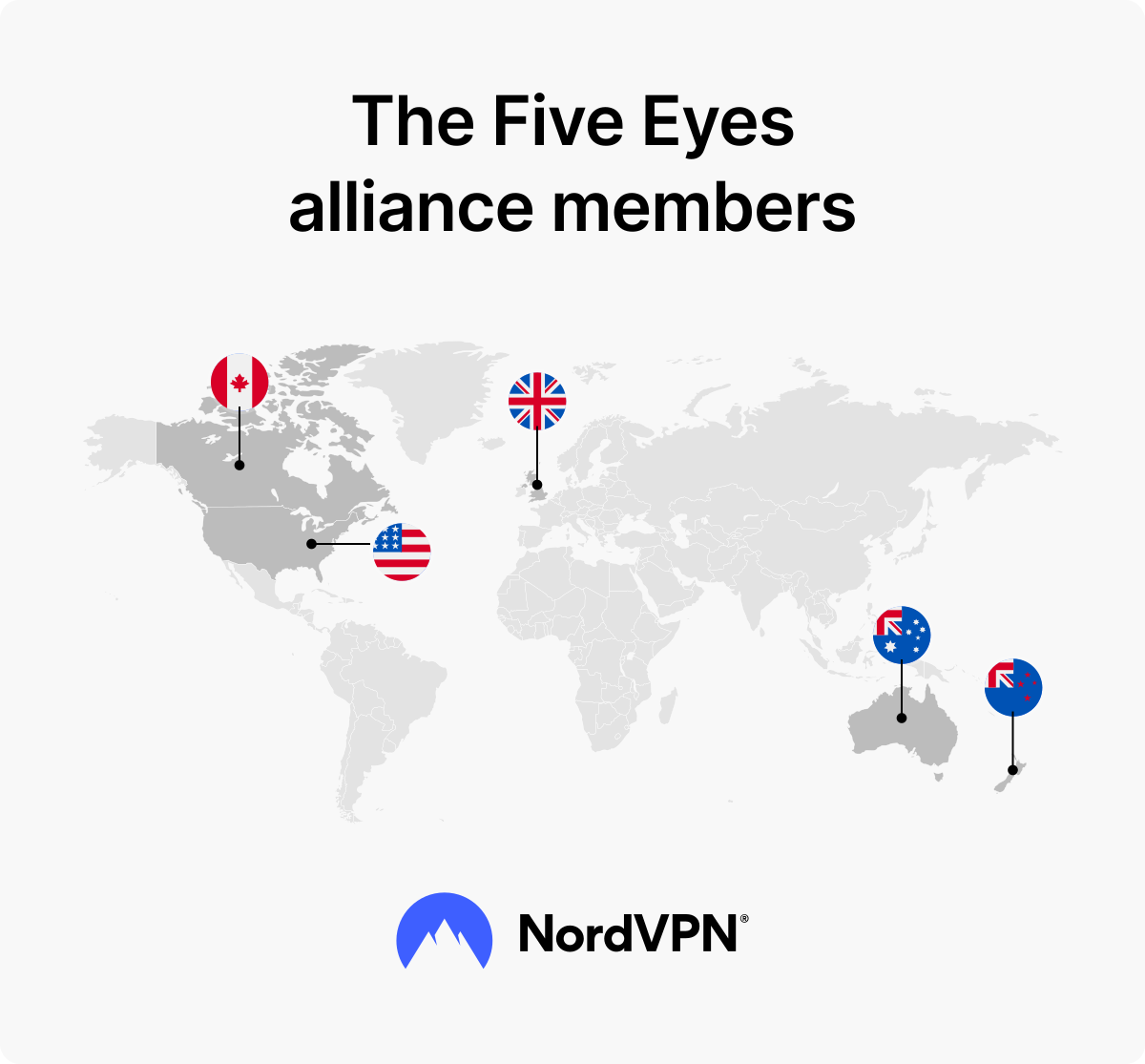
Each member country runs several intelligence agencies, but the Five Eyes partnership leans mainly on one signals intelligence (SIGINT) agency from each. These agencies intercept and analyze electronic communications — phone calls, internet traffic, radio transmissions, and other digital data. They gather foreign intelligence, watch for cyber threats, and share what they find to protect the security interests of all five nations.
| FVEY member country | Primary SIGINT agency | Primary role |
|---|---|---|
United States | National Security Agency (NSA) | Signals intelligence, cybersecurity, and foreign intelligence collection |
United Kingdom | Government Communications Headquarters (GCHQ) | Signals intelligence, cyber defense, and support for UK national security |
Canada | Communications Security Establishment (CSE) | Foreign signals intelligence and cybersecurity for the Canadian government |
Australia | Australian Signals Directorate (ASD) | Signals intelligence, cyber operations, and protection of Australia’s government networks |
New Zealand | Government Communications Security Bureau (GCSB) | Signals intelligence, cybersecurity, and protection of national communications systems |
Unlike NATO, the Five Eyes alliance operates without a permanent headquarters, governing body, or central agency. Instead, the member agencies work together directly, under sharing arrangements they’ve built up over the years. Each agency still answers to its own country’s laws, oversight bodies, and government. They simply pass relevant intelligence along to their trusted partners.
What does the Five Eyes alliance do?
The Five Eyes alliance allows its members to share intelligence that helps them identify and respond to national security threats.
Although the alliance originally focused on signals intelligence (SIGINT), today the cooperation covers areas such as:
- Signals intelligence. Members collect and share data from electronic signals and communications, including phone calls, radio, satellite, and internet traffic. This intelligence can help governments understand the activities and intentions of foreign states, organizations, and other potential security threats.
- Cybersecurity. Five Eyes agencies share information about cyberattacks, vulnerabilities, malware, and state-backed threat actors. They also regularly issue joint cybersecurity advisories to help governments, businesses, and critical infrastructure organizations respond to potential threats.
- Counterterrorism. Members exchange intelligence about terrorist organizations, suspected plots, and planned attacks — cooperation that helps authorities track cases spanning multiple countries.
- Counterintelligence. Five Eyes agencies cooperate to identify and respond to espionage, foreign interference, and other activities by foreign intelligence services. This can include sharing information about cyber espionage, attempts to obtain sensitive government information, and interference in national institutions.
- Other intelligence. Five Eyes cooperation has expanded beyond signals intelligence. Members may also share human intelligence (HUMINT) gathered from human sources and geospatial intelligence (GEOINT) based on satellite imagery, maps, and other location-based data when it supports shared national security goals.
Publicly known surveillance programs provide some examples of how Five Eyes countries collect and share intelligence. ECHELON is a multinational signals intelligence system associated with the Five Eyes partnership.
Other programs belong to individual member agencies. The NSA runs NSA surveillance programs like PRISM, which collects certain communications from US technology providers, and XKeyscore, a tool for searching and analyzing collected intelligence. The UK’s GCHQ operates Tempora to collect communications from fiber-optic cables. These national programs aren’t Five Eyes programs themselves, but the agencies may share some of the intelligence they collect with other Five Eyes members.
The history of the Five Eyes alliance
The Five Eyes alliance grew over decades as governments deepened their intelligence cooperation to keep up with new security challenges. The timeline below covers the alliance’s key milestones.
| Year | Milestone |
|---|---|
1941 | British and American codebreakers begin secret intelligence cooperation at Bletchley Park during World War II. |
1943 | The BRUSA Agreement formalizes wartime cooperation on communications intelligence between the two governments. |
1946 | The UKUSA Agreement establishes a permanent intelligence-sharing partnership between the United Kingdom and the United States. This agreement remains the legal foundation of the Five Eyes alliance. |
1948 | Canada joins the UKUSA Agreement. |
1956 | Australia and New Zealand formally become UKUSA partners, creating the Five Eyes alliance as it exists today. |
1950s-1960s | During the Cold War, the alliance focuses largely on monitoring the Soviet Union and other Eastern Bloc countries through signals intelligence. |
1970s onward | Five Eyes partners develop the ECHELON system, a multinational signals intelligence network designed to intercept international communications. |
2010 | The UKUSA Agreement is publicly released after decades of being classified, giving researchers and the public insight into the alliance’s origins. |
2013 | Documents disclosed by former NSA contractor Edward Snowden reveal details about intelligence sharing and surveillance programs, bringing the Five Eyes alliance into the global spotlight. |
The alliance has adapted as technology has changed. It started with intercepted radio communications during World War II and later expanded to satellite communications and internet traffic, as well as cybersecurity, digital forensics, and tracking foreign cyber threats.
Although many operational details remain classified, the Five Eyes is far more openly acknowledged today than it was during the Cold War, when governments barely admitted it existed. Today, member governments openly publish joint cybersecurity advisories, announce coordinated actions against cybercriminal groups and state-backed hackers, and talk publicly about their shared security priorities.
The Five Eyes alliance today
The Five Eyes is currently still active, and its members continue to share intelligence on common security threats. While signals intelligence remains at the heart of the alliance, the five countries have adapted their cooperation as technology and global security priorities have changed.
Today, Five Eyes countries put more emphasis on issues such as cyberattacks, foreign interference, terrorism, emerging technologies, and threats to critical infrastructure. Their intelligence and cybersecurity agencies regularly exchange information about new threats and publish joint cybersecurity advisories. In recent years, they have also coordinated responses to state-backed hacking campaigns, ransomware, and attacks targeting government systems and critical services.
Artificial intelligence has become another recent focus. Five Eyes members are exploring how AI could shape intelligence analysis, cybersecurity, critical infrastructure protection, and disinformation campaigns, while weighing the privacy and security risks these technologies bring.
The partnership now also includes not only intelligence agencies. Ministers from the five countries meet through the Five Country Ministerial to discuss national security, public safety, migration, border security, and technology. The alliance has changed significantly since its early days, but intelligence sharing between the five countries remains at its core.
Five Eyes vs. Nine Eyes vs. Fourteen Eyes
The Five Eyes isn’t the only intelligence-sharing arrangement involving its members. The Nine Eyes and Fourteen Eyes bring additional countries into intelligence cooperation, but they don’t give every member the same level of access or create partnerships as closely integrated as the Five Eyes. The names reflect the number of countries in each group. The table below compares the three alliances.
| Alliance | Member countries | Overview |
|---|---|---|
Five Eyes (FVEY) | Australia, Canada, New Zealand, the United Kingdom, the United States | The closest intelligence-sharing partnership, built on the UKUSA Agreement and focused on signals intelligence. |
Nine Eyes | Five Eyes members, plus Denmark, France, the Netherlands, and Norway | A broader intelligence-sharing arrangement that allows additional cooperation on selected intelligence and security matters. |
Fourteen Eyes (SIGINT Seniors Europe) | Nine Eyes members, plus Belgium, Germany, Italy, Spain, and Sweden | An expanded forum for signals intelligence cooperation among 14 countries. It isn’t simply a larger version of the Five Eyes and doesn’t offer all members the same level of integration. |
These alliances cooperate on intelligence and security, but they aren’t top-down organizations with a single chain of command. They’re a web of separate agreements, partnerships, and long-standing relationships between governments and their intelligence agencies. The bigger the group gets, the thinner the cooperation tends to be. The original five members still share intelligence the most closely.
Privacy concerns around the Five Eyes alliance
The Five Eyes alliance serves legitimate national security goals — but like any large surveillance apparatus, it has raised questions about privacy and oversight. Most of what the public knows about these issues came from the 2013 Snowden disclosures, which revealed the scale of the alliance’s intelligence-gathering activities.¹ Main privacy concerns include:
- The scale of data collection. The Snowden documents showed that some Five Eyes programs collected communications data on a very large scale. For example, the NSA collected phone records from millions of Verizon customers under a secret court order.² The UK’s GCHQ ran a program called Tempora that tapped fiber-optic cables carrying global internet traffic.³ Member governments argue that bulk collection is necessary to identify genuine threats among vast amounts of data, but privacy advocates question whether the scale is proportionate to that goal.
- Intelligence sharing and domestic legal protections. Each Five Eyes country has laws designed to protect its own citizens from surveillance. Privacy advocates have raised a concern that members could share intelligence about each other’s citizens in ways that bypass those domestic protections.⁴ Member governments deny using the alliance to circumvent national law, but because the details of intelligence sharing remain classified, the public has limited ability to verify exactly what is exchanged.
- Limited public oversight. For decades, the Five Eyes governments did not publicly confirm the alliance existed at all. While the partnership is now openly acknowledged, many operational details remain classified, and oversight mechanisms differ from country to country.⁵ Organizations like Privacy International argue this secrecy makes it difficult for the public to assess whether surveillance activities are lawful and proportionate.⁶
- Debates over encryption. Five Eyes governments have expressed concern that widespread end-to-end encryption limits their ability to investigate serious crimes like terrorism and child exploitation. In a 2020 joint statement, they called on tech companies to enable lawful access to encrypted content.⁷ Security experts and civil society groups have pushed back, warning that bad actors could exploit any built-in access point, weakening digital security for everyone.⁸ This remains an active and unresolved policy debate.
As people have become more aware of government surveillance, interest in privacy tools like encrypted messaging apps and VPNs has grown. This has also started a wider debate about how governments can protect national security while respecting people’s privacy.⁹
The Five Eyes alliance and the encryption backdoor debate
One of the alliance’s most contested issues is encryption — specifically, whether tech companies should be forced to give governments access to protected communications.
The most concrete recent example comes from the UK, a Five Eyes member. In early 2025, the UK Home Office served Apple with a Technical Capability Notice under the Investigatory Powers Act 2016, demanding access to end-to-end encrypted iCloud data. The notice reportedly applied to users worldwide.¹⁰ Apple refused, withdrawing its Advanced Data Protection feature for new UK users in February 2025 and challenging the order at the Investigatory Powers Tribunal.¹¹ The demand triggered a diplomatic dispute with the US — another Five Eyes member — and the UK later issued a revised notice targeting British users only. Apple filed a fresh legal challenge, with tribunal hearings continuing into 2026.¹²
This fight has roots in a 2018 Five Eyes joint statement declaring that “privacy is not absolute” and warning that members “may pursue technological, enforcement, legislative or other measures” to achieve lawful access.¹³ In 2020, the alliance, joined by India and Japan, called directly on tech companies to build lawful access into encrypted platforms, citing public safety risks.⁷
The debate over whether encryption backdoors are safe remains unresolved, and encryption backdoor demands like the UK’s show it isn’t going away anytime soon.
How to reduce your exposure to online surveillance
While complete online privacy is out of reach, you can limit unnecessary exposure of your activity and personal information. These measures aren’t designed to interfere with legitimate government surveillance carried out for national security and public safety, but they can help reduce everyday tracking and data collection:
- Use encrypted communication tools. Choose messaging apps that offer end-to-end encryption, which protects the contents of your conversations so that only you and the intended recipient can read them.
- Use a VPN. A VPN encrypts your internet traffic and routes it through a VPN server. A VPN hides your IP address by changing it to the IP address of the remote server. This encryption makes your traffic unreadable to anyone who might intercept it and changes what your ISP can see. It will know that you’re connected to a VPN, but not the websites you visit through the encrypted connection. As a result, you’re less likely to be tracked with a VPN through your IP address or network traffic.
- Use secure browsers and search engines. Private browsing options like incognito mode won’t protect your browsing activity. They only keep your activity out of the device’s history and clear cookies after the session. Browsers like Tor and secure search engines keep your online footprint more private. If you’re curious about the difference between Tor vs. a VPN, check out our article comparing the two.
- Avoid tracking cookies. Tracking cookies follow your behavior across different websites, chipping away at your privacy. Clear your cookies regularly and use a tracker blocker.
- Minimize data sharing. Be cautious about what personal information you share online and with whom because it can be used for profiling and surveillance. Adjust privacy settings on social media to make your posts and personal information available only to your network.
- Secure your devices. Keep your operating system and apps up to date — outdated software often contains vulnerabilities that hackers exploit to plant spyware and other threats.
References
¹ BBC News, “Edward Snowden: Leaks that exposed US spy programme,” BBC News, 2014. [Online]. Available: https://www.bbc.com/news/world-us-canada-23123964 opens in a new tab
² G. Greenwald, “NSA collecting phone records of millions of Verizon customers daily,” The Guardian, 2013. [Online]. Available: https://www.theguardian.com/world/2013/jun/06/nsa-phone-records-verizon-court-order opens in a new tab
³ E. MacAskill, J. Borger, N. Hopkins, N. Davies, and J. Ball, “GCHQ taps fibre-optic cables for secret access to world’s communications,” The Guardian, 2013. [Online]. Available: https://www.theguardian.com/uk/2013/jun/21/gchq-cables-secret-world-communications-nsa opens in a new tab
⁴ Yale Law School, “Newly Disclosed Documents on the Five Eyes Alliance and What They Tell Us About Intelligence Sharing,” Yale Law School Media Freedom and Information Access Clinic, 2018. [Online]. Available: https://law.yale.edu/mfia/case-disclosed/newly-disclosed-documents-five-eyes-alliance-and-what-they-tell-us-about-intelligence-sharing opens in a new tab
⁵ Electronic Frontier Foundation, “Five Eyes Unlimited: What A Global Anti-Encryption Regime Could Look Like,” EFF, 2017. [Online]. Available: https://www.eff.org/deeplinks/2017/06/five-eyes-unlimited opens in a new tab
⁶ Privacy International, “The Five Eyes Fact Sheet,” Privacy International, 2013. [Online]. Available: https://privacyinternational.org/learn/five-eyes opens in a new tab
⁷ U.S. Department of Justice, “International Statement: End-To-End Encryption and Public Safety,” DOJ, 2020. [Online]. Available: https://www.justice.gov/archives/opa/pr/international-statement-end-end-encryption-and-public-safety opens in a new tab
⁸ Global Encryption Coalition, “CDT, GPD and Internet Society Reject Time-Worn Argument for Encryption Backdoors,” Global Encryption Coalition, 2020. [Online]. Available: https://www.globalencryption.org/2020/10/cdt-gpd-and-internet-society-reject-time-worn-argument-for-encryption-backdoors/ opens in a new tab
⁹ Electronic Frontier Foundation, “EFF’s Game Plan for Ending Global Mass Surveillance,” EFF, 2015. [Online]. Available: https://www.eff.org/deeplinks/2015/01/effs-game-plan-ending-global-mass-surveillance opens in a new tab
¹⁰ The Washington Post, “U.K. orders Apple to let it spy on users’ encrypted accounts,” 2025. [Online]. Available: https://www.washingtonpost.com/technology/2025/02/07/apple-encryption-backdoor-uk/ opens in a new tab
¹¹ Apple, “Apple can no longer offer Advanced Data Protection in the United Kingdom,” Apple Support, 2025. [Online]. Available: https://support.apple.com/en-gb/122234 opens in a new tab
¹² The Guardian, “Apple launches legal challenge against UK government data access,” 2026. [Online]. Available: https://www.theguardian.com/technology/2026/aug/03/apple-legal-challenge-uk-government-data-access opens in a new tab
¹³ Australian Department of Home Affairs, “Statement of Principles on Access to Evidence and Encryption,” 2018. [Online]. Available: https://www.homeaffairs.gov.au/nat-security/Pages/statement-of-principles-on-access-to-evidence-and-encryption.aspx opens in a new tab
Online security starts with a click.
Stay safe with the world’s leading VPN