What is the dark web?
The dark web refers to a hidden part of the internet that isn’t indexed by standard web search engines and can’t be accessed through regular browsers. Instead, internet users must access the dark web using special tools, most commonly The Onion Router (Tor), which routes internet traffic through layers of encrypted relays to obscure a user’s identity and location. The dark web is often associated with darknet markets, cybercrime, and other illegal activity. And while crime is definitely a big part of the dark web, there’s more to it. It also hosts many privacy-focused communities, whistleblower platforms, and resources for users living under censorship.
The dark web is a network of websites and services that are intentionally concealed from the general public. The term specifically describes the encrypted portion of the “deep web,” where site operators hide their servers and users rely on layered encryption to maintain secrecy. Unlike the broader deep web, which includes everyday private content such as email inboxes or cloud storage, the dark web refers strictly to hidden, anonymized online spaces.
What does the dark web look like?
Despite its reputation or representation in movies and media, the dark web does not look futuristic or high-tech. In many ways, it resembles the clear web (the regular web you’re used to) — pages load in a browser, links lead to other pages, and navigation is familiar.
However, most dark web websites are much simpler in appearance. They tend to be plain, text heavy, and minimal because their creators prioritize privacy, anonymity, and quick setup, not design. You’d rarely see polished visuals, detailed graphics, or modern layouts. Instead, you’d encounter simple pages with lists of links, brief descriptions, or plain text menus.
Also, dark web sites don’t end with “.com,” “.org,” “.edu,” or “.gov.” Instead, dark web URLs will use the “.onion” domain and will be long, random combinations of letters and numbers. These addresses are hard to memorize, but usually, there’s no need to do that anyway, because they change very often. Many dark web websites disappear quickly, either because authorities take them down, owners abandon them, or scammers replace them with fakes.
Because of how onion routing works, Tor connections are often slower or less consistent than regular internet traffic, which means that Tor websites may load slowly or behave unpredictably from one visit to the next. The Tor browser wraps data in different layers of encryption (like an onion) and sends it through a network of volunteer-run servers scattered around the world. Each server the data passes through sheds away a layer of encryption and sends the partially decrypted message to the next destination. The process repeats until the message arrives at its intended destination. While this technique increases Tor’s security, it slows down the performance.
Surface web vs. deep web vs. dark web
To better understand what the dark web is, you should compare it to the other two layers that form the structure of the World Wide Web — the surface web and the deep web.
- The surface web (also known as the clearnet, clear web, visible web, indexed web, or open web) consists of all the public websites you can find online by typing their URLs into your browser’s address bar or looking them up on Google and other web search engines. A few examples of these pages would be a cooking blog, an online clothing shop, a social media platform, or a news site.
- The deep web (also the invisible web or hidden web) is all content online that isn’t part of the surface web. Standard search engines like Bing or Google don’t index deep web pages. Most of the deep web is hidden behind a password or paywall. One example of the deep web would be your online banking platform. It’s still on the part of the internet that’s reached from the surface web, but it’s not accessible without your login credentials. Even though most people access the deep web every day, they rarely notice it because it feels like regular browsing.
- The dark web (or the darknet) is a subset of the deep web. Traditional search engines don’t index the dark web websites, which means they don’t appear in regular search results. Accessing these sites requires specialized software.
You can think of the internet as an iceberg with different parts of it more or less visible.
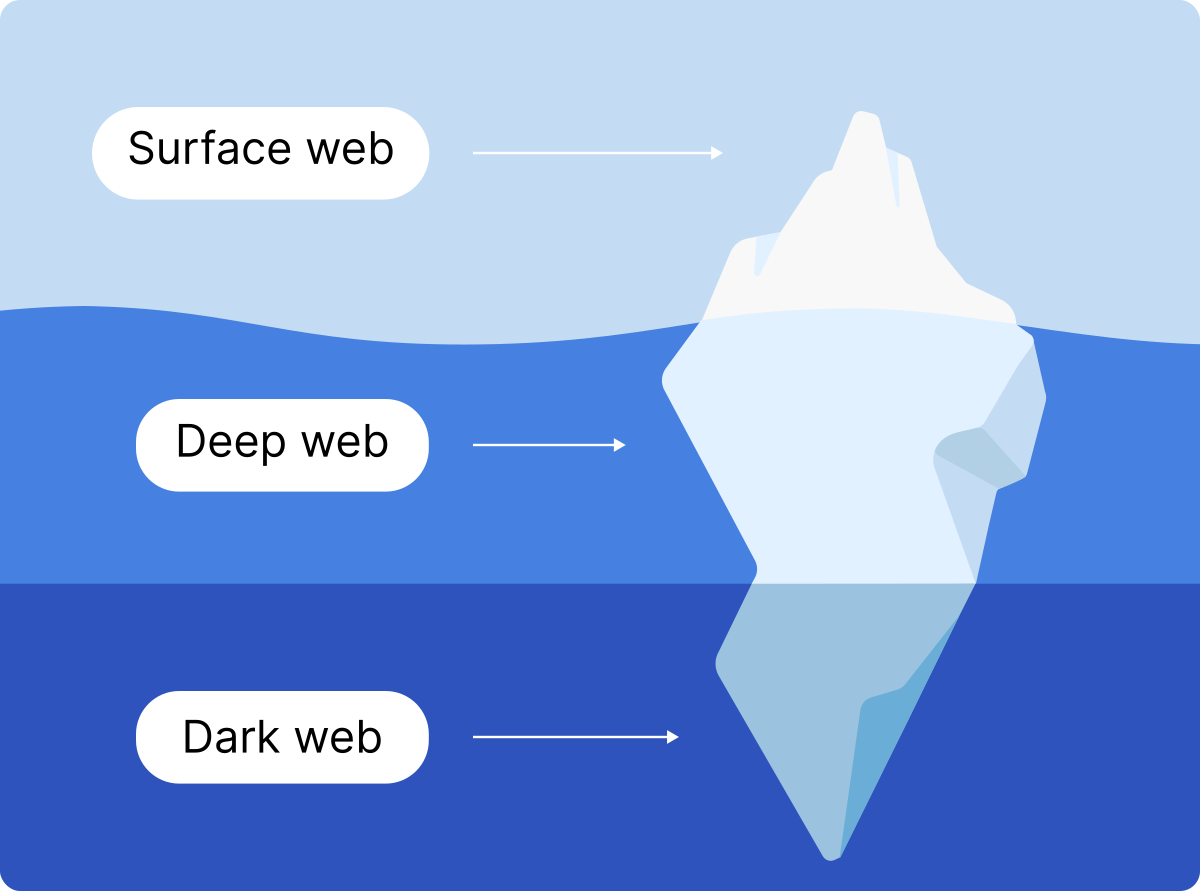
The surface web is part of the iceberg above the water, visible and accessible to everyone. Then the deep web is right under the water — it’s less accessible, but basic swimming skills would be enough to get there. Meanwhile, the dark web is part of the iceberg, deepest in the water — you’d need special diving equipment to reach it.
History of the dark web
Created by Ian Clarke in 1999, the dark web started as a final project at the University of Edinburgh. The original intent was to create a decentralized peer-to-peer file-sharing program.
The project soon evolved to become Freenet — a platform for free speech online. Users could discuss, share, and publish information anonymously and free of government censorship.
Freenet’s release to the public in 2000 helped activists to bring attention to the need for a way to stay anonymous online. It was followed by the Tor network, created by the US intelligence community to communicate in secret. Released to the public in 2004, Tor later became a browser offering easier access to the dark web.
Once cryptocurrencies entered the picture in 2009, Silk Road and other dark web marketplaces started popping up on the dark web, making it the place to be for various criminals.
To learn more about dark web history, check out our video on the topic:
What is on the dark web?
The dark web hosts an enormous variety of content. Because it operates as a hidden network, users rely on it for different reasons — some harmless, some dangerous, and some outright illegal:
Marketplaces
Some of the most visible parts of the dark web are its marketplaces. These sites operate like unregulated online shops where people trade goods and services anonymously, usually with cryptocurrency. While a few focus on legal items, many offer questionable or illegal products such as forged documents, counterfeit goods, or illicit substances. Markets frequently shut down, move, or rebrand to avoid law enforcement efforts, which makes them unpredictable. Because of the anonymous environment, scams and fake listings are extremely common.
Interesting yet worrying fact: According to NordVPN’s dark web market case study, payment card data is the most commonly found item in dark web marketplaces, followed by full personal identity data sets and driver’s licenses.
Forums and social networks
Dark web forums and social networks function as anonymous meeting places for all kinds of discussions. Some communities talk about privacy, technology, or cybersecurity, but others drift into harmful topics. Conversations may include trading tips for sending large volumes of spam emails, coordinating a DDoS attack, or controlling a botnet. Because users can hide their identities, these spaces tend to mix legitimate curiosity with criminal intent.
Whistleblower platforms
Whistleblower platforms provide a secure way for people to share sensitive information without revealing their identity, and many of these are hosted on the dark web for extra security. Journalists, activists, and researchers use them to receive documents safely in regions with censorship or government surveillance. These platforms depend on strong encryption and anonymous communication tools. Their purpose is to protect sources, not to host harmful material. Even so, operators must constantly guard against attacks from hostile governments, criminal groups, or other parties attempting to disrupt the service or expose users.
Data breach websites
Data breach websites collect and share databases exposed in hacks or leaks. Some operate with the goal of transparency, helping people see whether their credentials have been compromised. Others are more malicious, spreading massive collections of stolen data that criminals use for impersonation. Many security tools now include a dark web alert, which notifies users when their personal details appear on these hidden sites. You can learn more about stolen data on the dark web in our research on payment cards on the dark web.
Hacking and cybercrime services
Sections of the dark web advertise tools and services linked to hacking and digital crime. Some pages claim to sell phishing kits or ransomware-as-a-service subscriptions. These environments are why strong cybersecurity awareness and malware protection are more important than ever.
Cryptocurrency tools
Cryptocurrency-related sites on the dark web offer wallets, mixers, and marketplaces built around anonymity. Some users turn to these tools for privacy, while others use them to hide funds or support illegal transactions. Because transactions are difficult to trace, criminals often exploit these platforms.
Illegal content and explicit material
The dark web also contains illegal or harmful content that is deliberately hidden from public access. These sites operate under heavy anonymity to avoid detection by authorities, making them difficult to track or shut down. Many of them pose serious risks to visitors, including deceptive downloads or files that behave unpredictably. Because of how secretive these networks are, this area of the dark web remains one of the most dangerous and tightly monitored.
What are the dangers of the dark web?
Many threats and illegal activity are associated with the dark web, earning it a reputation as a dangerous part of the internet.
Malware infection
Verifying whether dark web sites are safe is challenging, so browsing on the dark web always comes with a higher risk of your device being infected by malware. Hackers could infect your device with ransomware and extort money from you or add your device to their army of bots used for various attacks.
Fraud and scams
Like malware infections, the likelihood of being scammed is much higher because many fraudulent schemes originate from the dark web.
Ponzi schemes, identity theft, credit card fraud, deed fraud, and other financial scams happen there, so if you fall victim to dark web scams, you can suffer significant financial loss and personal harm. And when a crime is committed, it’s much more challenging for law enforcement to track down the cybercriminals and get your money back.
Inappropriate content
The dark web has such a sinister reputation because it contains inappropriate content. From hacker forums and illegal pornography to terrorists organizing their operations, the dark web covers content you’d sleep better not knowing about.
Dark web marketplaces
While the dark web itself is not illegal, participating in dark web markets is. Selling or buying goods and services on a dark web market can lead to legal repercussions, even if you’re unaware that the marketplace is illegal.
Extremist ideologies
Some dark web forums promote extremist ideologies, including terrorism and hate speech. These platforms may provide a breeding ground for radicalization and threaten public safety.
Zero accountability
Most dark web users feel anonymous and engage in illegal activities without fear of being identified or held accountable. You never know when a minor negative comment about another user will trigger them to cyberbully or hack you personally.
How to know if your personal information is on the dark web
Since a big part of dark web businesses is selling and buying stolen data, you may wonder if your data is on the dark web.
The chance that some of your information is on the dark web is high. Too many data breaches happen, with email addresses, phone numbers, and passwords getting leaked every day. Criminals often steal giant databases and post them on forums or sell them in large bundles.
Fortunately, you can use dark web monitoring tools or data breach scanners to check if your credentials have ended up on the dark web. These services alert you when your information appears on hidden platforms so you can take action before criminals misuse it.
What to do if your personal information is for sale on the dark web
If a monitoring service notifies you about your data being on the dark web, act quickly to limit the damage:
- 1.Change your password immediately. Go to the affected account and use a unique combination of letters, numbers, and symbols as your new password. Change the passwords on all the other accounts if the old password was reused anywhere else.
- 2.Enable two-factor authentication (2FA). Even the strongest passwords can be exposed in data breaches, so you should have a failsafe when that happens. If you set up 2FA on your account, your password won’t be enough to access it — hackers will need an additional code or confirmation that you get in a text message, email, or an app.
- 3.Review your bank statements. Some breached accounts may hold your payment card details. If that’s the case, review your bank statements to see if any unknown transfers or other suspicious activity appear there.
- 4.Contact your bank. If bank or payment card details were found on the dark web, inform your bank about the possible hack. You can block your payment cards or mark your account as compromised to prevent unauthorized money transfers.
- 5.Check your device for malware. While it’s more likely that your credentials ended up on the dark web after some online service was breached, the chance that you were hacked personally is never zero. So use an antivirus scanner to check your devices for malicious software.
How to protect your personal information from data theft
You can drastically lower your risk of data theft by building strong online habits:
- Learn to spot phishing emails and fake websites. Besides data breaches, much personal information gets exposed when people click links in phishing emails and enter their data on scam websites. You can avoid exposing your information if you learn how to spot these fake sites.
- Don’t provide more information online than necessary. Online platforms can ask for a lot of information — from your email address to your home address or payment card details. Only provide this information on sites you trust and only when it’s actually necessary.
- Use multiple email addresses. Most email providers are free, so you can create more than one email address. Use one email address for important and sensitive communication, such as work or family-related emails, as well as emails from insurance companies or health institutions. Meanwhile, use another email address for less critical data and accounts.
- Create unique passwords for every account. Reusing passwords is one of the worst internet habits. If a tiny website you used years ago gets breached, you may lose data and have your bank details exposed on a completely different platform. Use unique and strong passwords to prevent that from happening.
- Use reliable anti-malware or antivirus software. A trustworthy service will help protect your device from malicious software, such as keyloggers or ransomware, from stealing your data and using it for identity theft.