Cybersecurity
statistics and insights
Explore key cybersecurity insights and statistics for 2025 and 2026 compiled by NordVPN
Data sources and compilation methods
Cybersecurity statistics on this page are based on publicly reported and media-covered incidents from global sources, including breach disclosures, law-enforcement complaints, and industry research. These figures are intended to highlight reported cybersecurity trends rather than represent the full scale of global cybercrime.
A full explanation of methodology, scope, sources, and limitations is available on the dedicated “Methodology and sources” page.
Methodology for NordVPN’s analysis on cybersecurity statistics
Methodology for NordVPN’s analysis on cybersecurity statistics
Cybersecurity overview of 2025
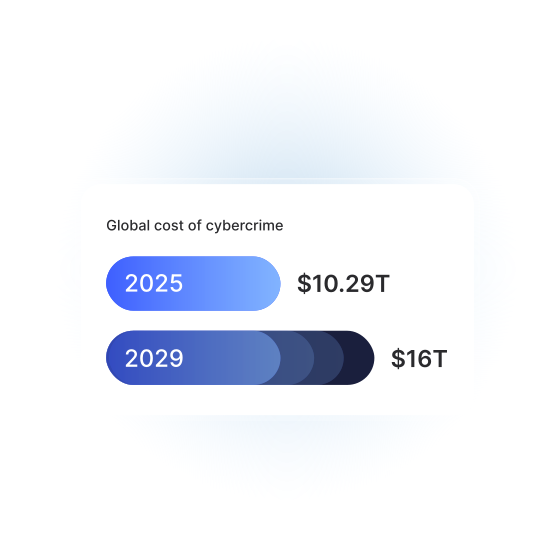
Cybersecurity in 2025 is marked by persistent ransomware operations, large-scale data breaches, and ongoing fraud and credential theft affecting organizations and individuals worldwide. Public reporting this year continues to document thousands of confirmed incidents across sectors, reflecting the steady pace of digital threats. Long-term economic models project that the global cost of cybercrime could approach $16 trillion annually by 2029 1 opens in a new tab , underscoring the expanding financial impact of an increasingly connected world.
Cybersecurity data breach statistics
Data breach statistics vary depending on whether they measure public disclosures, regulatory notifications, or investigated incidents. These figures describe different parts of the breach lifecycle. The following statistics outline breach frequency and scale.
How often do data breaches happen?
In 2025 alone, our analysis captured approximately 8,500 distinct data breach incidents. The Identity Theft Resource Center (ITRC) reported 2 opens in a new tab 2,563 publicly disclosed data compromises through the first three quarters of the year. By comparison, publicly available breach data revealed approximately 2,900 unique events in Q3 alone.
During H1 2025, 96.9% of breach incidents involved confirmed or suspected cyberattacks. The ITRC reports 3 opens in a new tab a lower number of 77.8% in H1 2025, and those attack-driven incidents alone exposed 114,582,621 individuals, or about 69% of all victims in that period.
Major data breaches of 2025
Cybersecurity attack statistics
Cybersecurity attack statistics reveal the true scale of digital threats facing individuals, businesses, and governments worldwide. While vendor telemetry and national cyber agencies report hundreds of millions — even billions — of attempted attacks each year, only a fraction of these incidents surface in public reporting.
In 2025, our research captured that cybersecurity attack events occurred approximately every 14 minutes, with around 85 distinct cybersecurity attack events per day. This includes all attack types — data breaches, ransomware, social engineering, malware, DDoS, and others.
The biggest cybersecurity attacks
Top cybersecurity threats and risks
The top cybersecurity threats include ransomware, phishing, credential theft, malware deployment, supply chain compromise, and cloud misconfigurations. These threat categories collectively accounted for 93% of all cyberattacks recorded by our analysis in 2025.
Ransomware
Ransomware was one of the most dominant cyber threats in 2025, accounting for 26% of all cyber threat events in 2025 — that’s one in every four incidents. A total of 4,850 distinct ransomware incidents were recorded by our analysis, meaning a ransomware attack occurred roughly every two hours throughout the year.
Cybercrime statistics
Cybercrime has become one of the most pervasive forms of economic crime worldwide, affecting consumers, businesses, and governments at unprecedented scale. Fraud, identity theft, and digital scams now account for millions of reported incidents each year, with losses ranging from individual account takeovers to systemic impacts measured in billions of dollars.
According to NordVPN’s cybersecurity statistics analysis, reported cybercrime losses reached $54–58 billion in 2025. Globally, however, it is reported 42-44 opens in a new tab that the cost of cybercrime is estimated to be about 15.6 trillion annually in 2029, with projections indicating it could increase to $12.2 trillion by 2031.
Furthermore, our analysis based on publicly available data of incidents where financial impact was disclosed shows that 79.7% of cybercrimes result in damages exceeding $1 million, with 27.2% escalating to severe costs of $10 million or more.
Cybersecurity statistics by industry
Cybersecurity risk varies sharply by industry, shaped by differences in data sensitivity, operational complexity, regulatory pressure, and attacker incentives. Sectors such as healthcare and finance face persistent exposure due to the value of personal and financial data, while retail, energy, government, and small businesses contend with a mix of high attack volume, uneven security maturity, and cascading supply chain effects.
Financial services and banking breach statistics
NordVPN’s analysis of publicly disclosed data shows that financial sector breach incidents made up ≈20.7% of all reported breaches, which is roughly 148 finance breach incidents per month. External reports 47 opens in a new tab confirm this figure and also state that finance accounts for roughly one-fifth of global breach notifications, according to multi-sector breach outlooks.
The average cost of a data breach in finance is reported 48 opens in a new tab to be about $6.08 million, roughly 22% higher than the global mean cost.
In 2024, the Global Survey of Identity and Security Leaders 49 opens in a new tab reported that 46% of financial institutions suffered a data breach in the past 24 months, making breach experience almost a coin flip over a two-year period.
Cybersecurity spending statistics
Our analysis reveals organizations collectively spending $6+ billion in breach aftermath costs in 2025, versus one proactive investment announcement.
-
SK Telecom: 2.3 trillion won (~$1.7B) compensation
-
Capital One: $425M settlement
-
AT&T: $177M settlement
-
PSNI: £119M ($150M) compensation fund
-
Infosys McCamish: $17.5M settlement
A 2025 review of a global survey 59 opens in a new tab notes that 93% of organizations increased their cybersecurity budgets by at least 10%, yet about 70% still rate their overall cyber readiness as “beginner” or “formative.”
A longitudinal survey by IANS and Artico Search 60 opens in a new tab shows that security accounted for 13.2% of total tech budgets in 2024, up from 8.6% in 2020, reflecting a clear shift toward security-first spending.
It is estimated 61 opens in a new tab that the global cyber insurance market will reach about $16.3 billion in 2025 and more than double by 2030 with a >10% annual growth rate.