The scope of the network
Our team identified more than 10,000 fake fashion stores built from a cloned template. The shops impersonate 166 recognizable brands, including Adidas, Ralph Lauren, Dr. Martens, Crocs, Massimo Dutti, and Birkenstock, across 26 countries. Ahead of Black Friday, 1,574 stores were still active as of November 3, 2026.
Our findings indicate a single operator behind the network. The hosting tools, registration times, and language used in the code suggest that the operator is likely Chinese speaking. They copied a WordPress template to create the stores, then changed the brand names, languages, currencies, and addresses to appeal to each market.
Many of the domains targeted Germany and France. In Germany, we found 78 domains ending in “.de” and 60 with the lookalike ending “.com.de.” In France, another 133 ended in “.fr” Both countries have large fashion markets and well-known brands that the operator can impersonate.
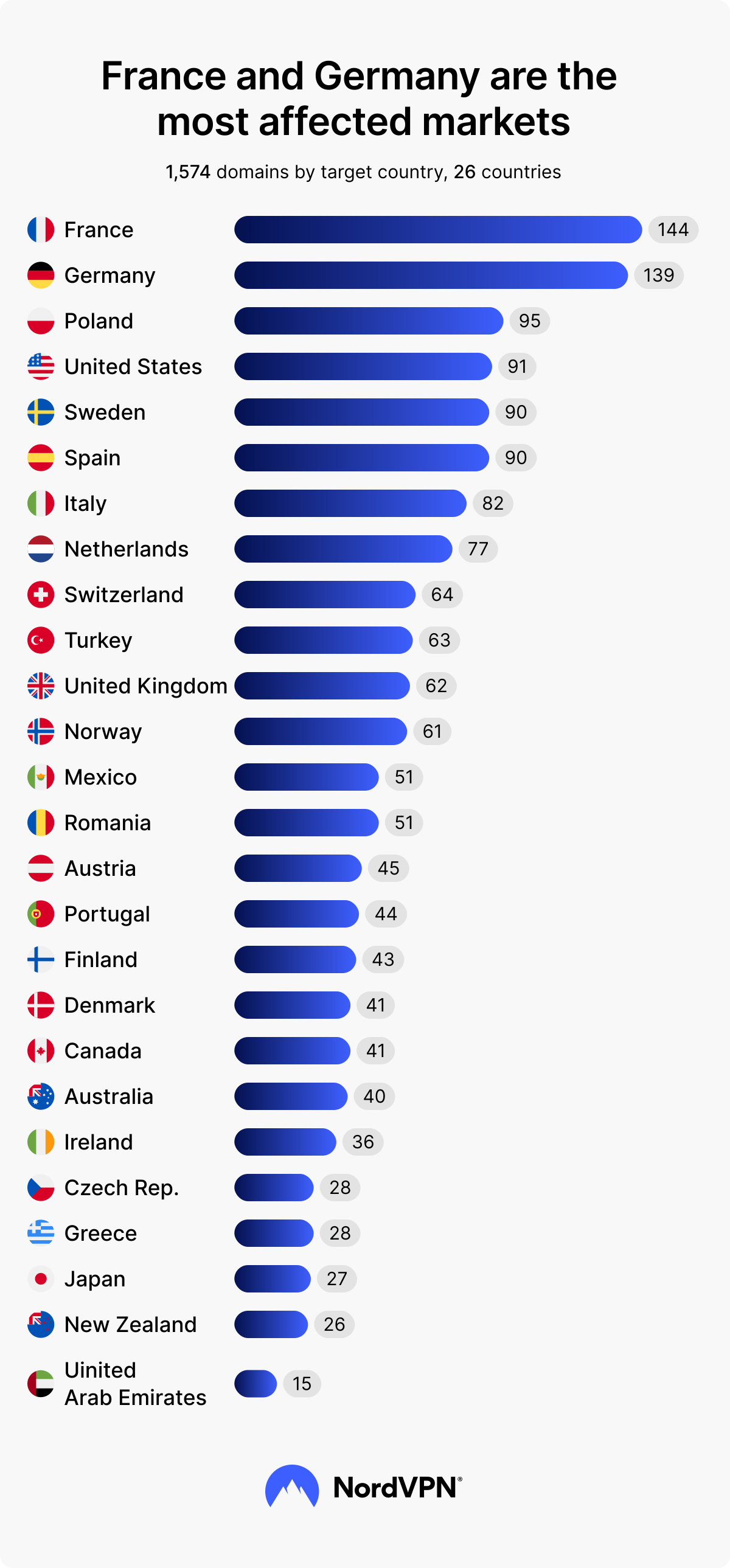
The German stores shared another detail — 117 listed the same fictitious identity and tax number on their legal disclosure pages, despite presenting themselves as separate businesses.
Rather than rely on paid ads that link directly to the shops, the operator built the sites to appear in organic search results. The stores’ search visibility has also put them in front of people using AI assistants. When we tested AI shopping assistants with queries in the local language, one assistant recommended a fake Vero Moda store in Spain alongside legitimate retailers such as Zalando and La Redoute and described a fake Dr. Martens site as the brand’s official Irish outlet.
How a single file exposed the network
Our investigation began with the stylesheet for a WordPress theme called Aurum. The 847-byte file had a distinctive fingerprint, which we found across thousands of domains. The stores also used the same theme version number, which includes a timestamp corresponding to August 15, 2025.
Other shared details helped us connect the stores. Several hundred domains exposed the same administrator username, and 914 domains used the same misspelling in a support email address. A similar number of legal pages shared identical creation timestamps. More than 100 shops also loaded product images from the operator’s staging domains.
Alongside shared infrastructure and account-linked markers, these details point to one operation rather than separate groups of scammers.
How convincing are these shops?
Each store is adapted to its target country, with the local language and currency, an address in a recognizable location, and familiar payment logos such as PayPal, Klarna, Visa, and Mastercard. Some addresses refer to real locations associated with unrelated businesses.
The logos on display do not match the gateways that actually process the transactions. Although the stores display PayPal and Klarna logos, our analysis found that they used other gateways to process payments. Shoppers who expect to use a familiar payment method may instead be asked to enter card details through a different system.
The stores use discount wording to attract shoppers, but they never say how much they have reduced the prices. On one fake Adidas site, sneakers were listed at €38-89. A fake Vero Moda site listed clothing at €12-22. Rather than state a percentage discount, the shops use words such as “outlet,” “sale,” and “Black Friday,” translated for each market and repeated across their pages.
What makes these shops rank so well
The operator built the stores to appear in Google search results. Most active stores we analyzed used SEO plugins to improve their search visibility. They also submitted product feeds and sitemaps to Google. Each store listed a median of 1,312 pages.
We found that 597 domains had been verified in Google Search Console, a tool that lets website owners monitor how their sites appear in Google search. This verification does not mean Google has checked whether the business is legitimate.
The stores appeared in searches for their names and products. AI assistants that search the web can find those pages and include them in their answers. In our tests, some assistants cited or recommended stores from the network. How each assistant selected and assessed those pages remains unclear.
The operator also reused expired domains. We confirmed 100 cases and identified several hundred more likely ones. Some older domains already have links from other websites or pages in search indexes, which may help a new site gain visibility. However, an older domain won’t necessarily rank well. For example, “diesel-uk.com” belonged to an engineering workshop in 2002. At the time of our investigation, it hosted a fake Diesel fashion store.
Red flags to watch for
Fake stores can resemble legitimate retailers, but details in their web addresses, payment options, and pricing may give them away. Look for these signs to help you identify fake shopping websites like the ones in this fake shop network:
- Unusual spelling in the domain. The operator adds letters, inserts hyphens, or uses country-style endings to create plausible-looking addresses — for example, “pradas.pl,” “vero-moda.es,” or “loewe.com.se.”
- Payment logos that don’t match checkout options. The stores display PayPal and Klarna icons, but our analysis found they process payments through other gateways. If the checkout options differ from those advertised, stop before entering your details.
- Promotion of an “outlet” or “sale” without a stated discount. The stores we analyzed never list an actual percentage off. Check the price against the brand’s official website rather than assuming the label indicates a deal.
This network is one source of Black Friday scams. Fraudulent stores also reach shoppers through social media ads, emails, and messages promoting steep discounts or limited-time deals. These links can lead to fake websites designed to look like familiar retailers and trick shoppers into handing over their payment details. Wherever you come across a deal, the same checks can help you spot a scam before you buy.
PRO TIP
If a product page lacks a return policy, business registration details, or any contact information beyond a form, don’t brush it off as a minor oversight. These are warning signs worth investigating. Learn more about how to protect yourself from fake shops.
How to shop more safely this Black Friday
These online shopping safety tips can help you spot suspicious stores and keep your payment details out of the wrong hands this Black Friday:
- Type the address yourself. Go to the brand’s official site directly, or use its app, instead of clicking through from a search result, social media post, or AI assistant suggestion.
- Check the domain closely. Look for extra letters, inserted hyphens, or unfamiliar country endings before trusting a site.
- Don’t rely on payment logos. Their presence doesn’t confirm that the store actually accepts a given payment method.
- Check for a specific price, not just promotional language. Words such as “Black Friday,” “outlet,” and “sale” do not establish that a product is discounted.
- Add a layer of technical protection. NordVPN’s next-gen antivirus* checks website reputations in real time and blocks known malicious and fraudulent sites before they load, which helps catch cases that slip past manual checks.
- Contact your bank promptly if you’ve entered card details on a suspicious site. Your bank can advise you on blocking the card and disputing charges.
*NordVPN’s next-gen antivirus is a digital threat protection tool that’s available on Windows and macOS. Learn what it is and how it works in the next-gen antivirus whitepaper.
PRO TIP
To check an unfamiliar domain, search for the store by name instead of following the link directly. If you find no reviews, or all of them were posted within a short span of time — such as all in the same week — take a step back before buying. You can also use a link checker to look for signs that the URL is unsafe.
Online security starts with a click.
Stay safe with the world’s leading VPN
