What is an MMORPG?
An MMORPG, which stands for massively multiplayer online role-playing game, is a type of online video game where you create a character and explore a virtual world alongside thousands of other players. MMORPGs combine the social scale of a massive online community with the adventure and character growth found in traditional story-driven games.
The core features that define an MMORPG include:
- Character customization. You create your hero’s appearance and select a class* when you first start the game. Your avatar grows stronger over time as you gain experience levels and equip powerful items.
- A persistent world. The game universe operates on a server that never sleeps. Major events like economic** shifts or territorial wars continue to happen even after you log off for the day.
- Social interaction. You share the game world with thousands of real people. Success depends on your ability to team up for raids, trade in open markets, or battle against rival players.
Some of the most played MMORPGs, such as World of Warcraft, The Elder Scrolls Online, and Final Fantasy XIV, all rely on these pillars to keep players engaged for years.
Game lingo explained
*In an MMORPG, a "class" is the specific job or role your character performs in the game, such as a warrior who fights up close or a wizard who casts spells from a distance.
**In an MMORPG, an “economy” is the virtual financial system where you buy, sell, and trade with other players. These games have their own currencies and player-run marketplaces that function like a real-world stock exchange. Supply and demand dictate prices here. When we say hackers "crash the economy," it means they flood the game with fake, duplicated money. This inflation destroys the value of the items players spent hundreds of hours earning.
MMO vs. MMORPG: What is an MMO?
MMOG, or more commonly MMO, stands for massively multiplayer online game. This term acts as a broad umbrella for any video game that allows a large number of players — hundreds or even thousands — to interact simultaneously on the same server.
While all MMORPGs are MMOs, not all MMO games involve role-playing. For example, a game can be a massive shooter or a strategy game without the character stats and story elements of a role-playing game (RPG).
Popular non-RPG examples include World of Tanks, which focuses on tactical vehicle combat, and PlanetSide 2, a massive first-person shooter. The defining feature of an MMO is the sheer scale of players, regardless of the genre.
How do MMORPGs work?
MMORPGs operate on a complex client-server architecture. When you launch the game on your device, it connects to a remote server hosted by the game developers. This server acts as the source for the MMORPG world, verifying every movement, transaction, and interaction to ensure fairness and continuity.
The gameplay loop typically follows a standard pattern:
- 1.You log in with a username and password, which connects your device to the game server.
- 2.You create or select a character and enter the world.
- 3.You level up by facing different challenges. These include PvE (player versus environment), where you fight computer-controlled monsters, and PvP (player versus player), where you battle against characters controlled by real people.
- 4.You find items and currency, which you can trade with other players via auction houses or direct exchange.
From a cybersecurity perspective, this constant data exchange creates multiple vulnerabilities, which we will discuss in detail in the cybersecurity threats in MMORPGs section.
MMORPG platforms
Developers release MMORPGs across various platforms to reach different types of players.
- PC MMORPGs. These titles, such as World of Warcraft and Final Fantasy XIV, usually offer the most complex gameplay mechanics, detailed user interfaces, and support for third-party modifications (mods).
- Console MMORPGs. Games like The Elder Scrolls Online are designed specifically for controllers and television screens, featuring simplified menus and text that are easy to read from your living room couch.
- Mobile MMORPGs. Titles like Lineage 2: Revolution focus on accessibility and often include auto-play features that allow your character to fight enemies and complete quests on their own, catering to short bursts of gameplay.
- Browser-based MMORPGs. Modern HTML5 titles like Flyff Universe allow instant access via a web browser, while older classics like RuneScape have largely migrated to downloadable clients — standalone software applications that you must install on your computer to play the game.
- Cross-platform MMORPGs. Games such as Albion Online allow players to use the same account across PC and mobile devices, which ensures their character’s level, items, and quest progress transfer seamlessly between platforms.
- Cloud MMORPGs. This emerging frontier streams the game video directly from a data center to your screen. This technology removes the need for an expensive gaming computer, but it relies on a fast and stable internet connection to play smoothly.
Most popular MMORPGs in 2025
The world of MMORPGs in 2025 features a mix of enduring titans and evolved classics that continue to dominate the market.
How we made this list
To find the most popular MMORPGs in 2025, we compared five major industry sources to see which games everyone is talking about. We looked at Google’s search results, Steam’s "Top sellers" category, and the 2025 recommendations from PCGamesN, Loot And Grind, and Mein-MMO. The list below includes the games that appeared most often across all these sources. Keep in mind that this is not a ranked leaderboard. We listed these titles in random order, so the game at number one is not necessarily better than the game at number ten.
1. Guild Wars 2
Guild Wars 2 remains one of the most played online games and retains a loyal following because the developers respect your time. The game uses a unique "horizontal progression" system, which means the gear you earn today stays relevant for years. This design choice allows you to take long breaks and return without feeling like you have fallen behind the rest of the community.
2. The Elder Scrolls Online
The Elder Scrolls Online remains popular for its unparalleled freedom. Unlike most games that restrict where you can go or what weapons you can use, this title lets you explore the entire fantasy world immediately and build any character style you want. This flexible design ensures you and your friends can explore any zone in the game world, regardless of your character's level.
On top of that, the combat is active and engaging — you must physically press buttons to block or dodge enemy attacks in real-time while using your magical abilities.
3. Final Fantasy XIV
Final Fantasy XIV sets itself apart by focusing heavily on its story. The game delivers epic narrative expansions that rival the quality of top-tier single-player games. The developers also strictly enforce rules against bullying and toxicity, which fosters one of the most welcoming communities in gaming.
4. Black Desert Online
Black Desert Online stands out for its stunning, realistic graphics and intense fighting style. Unlike games where you simply click a single button to attack, this title plays more like a fighting game — you must memorize button combinations to perform flashy attacks. The developers constantly update the character classes, which makes this game one of the best choices for players who want a test of skill and fast-paced action.
5. Star Wars: The Old Republic
Star Wars: The Old Republic lets you live out your own sci-fi movie with fully voiced storylines for every character class. The game focuses heavily on your personal choices during dialogue, so it often feels like a single-player adventure that you happen to share with other people.
6. New World: Aeternum
New World: Aeternum blends intense action combat with a supernatural 17th-century setting. The massive "Aeternum" update completely reworked the main story and improved the leveling process, which makes the journey much smoother for new adventurers. This overhaul ensures you can jump straight into the action without hitting the roadblocks that existed in the original version.
7. Lost Ark
Lost Ark is perfect for players who want fast-paced combat with a top-down camera view. You fight huge hordes of enemies at once using explosive abilities, much like in classic action games, but on a massive multiplayer scale. This unique perspective makes the battles feel faster and more chaotic than traditional MMOs.
8. The Lord of the Rings Online
The Lord of the Rings Online offers the unique chance to walk through Middle-earth exactly as J.R.R. Tolkien described it. The game prioritizes a slow, immersive journey through the book's locations over fast-paced action. This dedication to the source material attracts fans who love world-building and exploration more than intense combat.
9-10: Old School RuneScape and RuneScape
Old School RuneScape and modern RuneScape remain popular because they offer deeply nostalgic yet actively updated content. These titles appeal to players who enjoy setting long-term goals and leveling up dozens of different skills in a world that rewards patience. This satisfying loop ensures your hard work always pays off, no matter how long you play.
Current cybersecurity threats in MMORPGs
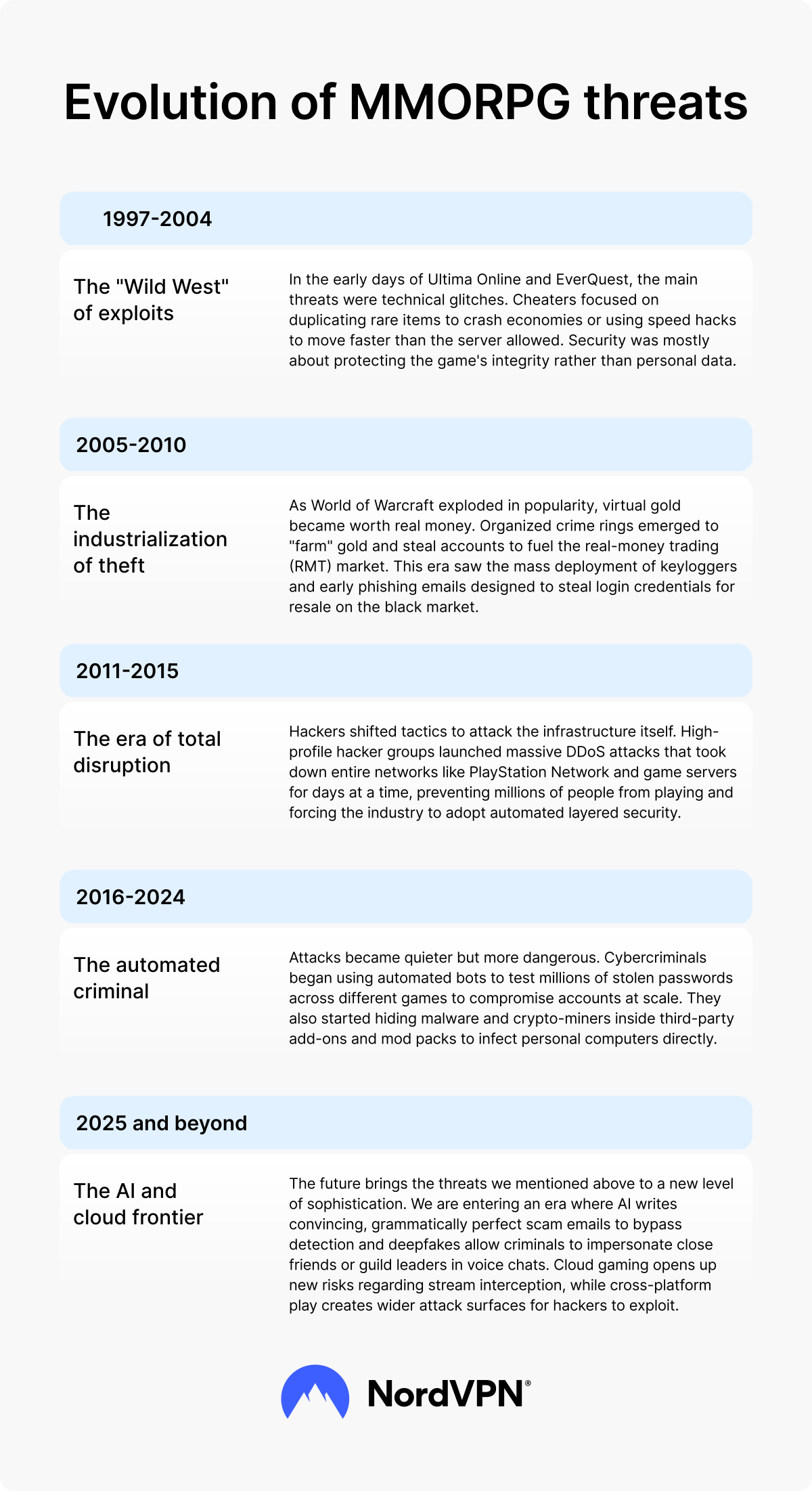
The constant data exchange in MMORPGs creates multiple security risks in online gaming. As these virtual economies grow, they attract cybercriminals looking to exploit security gaps for profit. These criminals target your game account using the same techniques they use to steal bank details or email passwords.
Account compromises
Your game account is the primary target because your digital items often hold real-world monetary value. Hackers use automated scripts to test thousands of stolen username and password combinations — a technique known as credential stuffing.
Attackers also use phishing emails that look like official support tickets to trick you into revealing your password. Others hide malicious software inside supposedly free game mods to record your keystrokes. Once inside, they strip your account of all valuable assets and gear or sell the character entirely on the black market.
Payment fraud and chargebacks
MMORPGs involve constant financial transactions, from monthly subscriptions to microtransactions for skins and mounts. Cybercriminals often use stolen credit card details to purchase in-game currency on fresh accounts.
When the rightful cardholder notices the transaction and reports fraud, the bank issues a chargeback, which reverses the payment. This chargeback costs the game developer money and often leads them to permanently ban any accounts linked to the stolen money, including players who thought they were just buying cheap currency.
Social engineering in player communities
The social nature of MMORPGs creates opportunities for manipulation. Attackers often infiltrate guilds or Discord servers, where they pretend to be friendly players or administrators. Through social engineering, they trick victims into clicking on malicious links or revealing personal details.
This breach of privacy can lead to severe consequences like doxxing, where bad actors hunt down your real-world identity or physical address to harass you, often as retaliation for in-game conflicts.
Infrastructure and server vulnerabilities
On a technical level, the game servers themselves face constant threats. DDoS attacks can flood game servers with junk traffic, which makes the game unplayable for thousands of users at once. Hackers also search for exploits in the server code to duplicate items, which floods the market and crashes the economy by making in-game currency worthless.
In worst-case scenarios, a mass data breach can expose the personal information of millions of users. Players should also understand how exposed IP addresses are used because attackers can target a specific home connection to disconnect a player during high-stakes competitive matches.
How developers secure MMORPGs
MMORPG developers apply many security measures to protect their virtual worlds and your personal data:
- Account security features. Most major games now require or strongly encourage you to use two-factor authentication (2FA). The system also sends you an alert if someone tries to log in from a suspicious location.
- Anti-cheat and anti-bot tools. Some developers use specialized software (like BattlEye) that runs in the background while you play. These tools detect cheating programs and ban automated bots that ruin the experience for everyone else.
- Payment security. MMORPG companies protect your wallet by using secure payment gateways. They also use AI security systems to spot and flag unusual purchasing behavior before fraud can occur.
- Server protection. Developers invest in strong infrastructure to block attacks that try to crash the game. They also perform regular maintenance to fix code vulnerabilities before hackers can exploit them.
- Community management. Moderation teams monitor chat channels to keep the game safe. They use reporting tools to spot harassment and remove scammers who try to trick players.
What players can do to protect themselves
While MMORPG companies do their best, you must also take proactive steps to protect yourself:
- 1.Use strong, unique passwords. Never reuse the same password across multiple game accounts. Use a password manager to generate and store complex credentials.
- 2.Enable 2FA. Always turn on two-factor authentication (2FA) if the game offers it.
- 3.Recognize phishing. Verify links carefully and never log in through prompts sent via email. If you receive a ban notification that appears to be from Discord, log in to your Discord account directly to check its status — the email is likely a Discord scam.
- 4.Use a VPN. A VPN for gaming masks your real IP address, which can protect you from targeted DDoS attacks and potential doxxing attempts. A VPN can also protect your internet traffic if you are playing on public Wi-Fi.
- 5.Avoid third-party mods or bots. Be careful when you decide to download game modifications — not all game mods are safe. Malicious actors often hide malware inside programs that play the game for you or tools that claim to generate infinite currency.
- 6.Be cautious in communities. Don’t share personal information in chats or Discord. Verify the identity of anyone asking for items or account details.
- 7.Secure your devices. Keep your operating system and antivirus software up to date to prevent drive-by malware attacks.
Online security starts with a click.
Stay safe with the world’s leading VPN
Future cybersecurity threats in MMORPGs
While current cybersecurity threats in MMORPGs rely on well-known tactics, the future of gaming security is becoming an arms race against sophisticated, automated technologies. As developers adopt new tech, hackers are finding ways to weaponize it.
- AI-driven phishing. We are moving past poorly written scam emails. Attackers are now using generative AI to create highly personalized, grammatically perfect AI scams. These bots can analyze a player's public activity and write messages that sound exactly like a guildmate or a customer support agent, which makes them nearly impossible to distinguish from the real thing. Current phishing statistics already show a massive surge in these AI-enhanced attempts.
- Deepfake social engineering. Social engineering is evolving beyond text. Malicious actors may soon use deepfake technology to clone the voices of famous streamers or trusted guild leaders in voice chats.
- Cloud gaming risks. As many MMORPGs move toward cloud streaming (where the game runs on a remote server rather than your PC), the risks shift. You won't have to worry about downloading viruses, but man-in-the-middle attacks could intercept the video stream itself, allowing hackers to hijack your session and control your character without ever needing your password.
- Cross-platform attack surfaces. With games now seamlessly connecting mobile, PC, and console players, the attack surface is wider than ever. A compromised smartphone with weak security could serve as a backdoor to access a high-value PC account that was otherwise secure.