What is artificial intelligence (AI)?
Artificial intelligence (AI) is the simulation of human intelligence by machines, most commonly computer systems. AI absorbs large amounts of information, analyzes it for patterns and correlations, and uses these patterns to create relevant outputs.
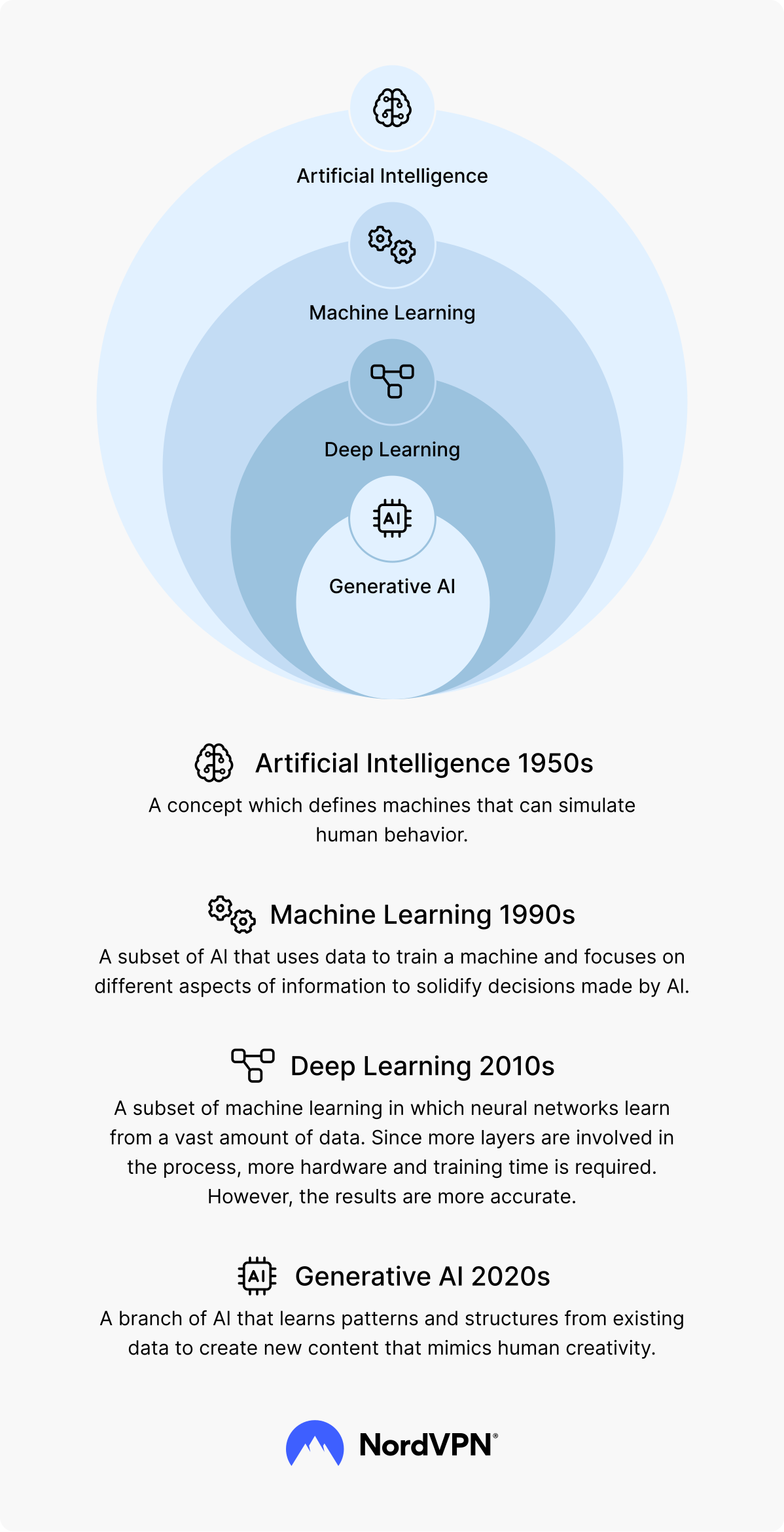
The term "artificial intelligence" was first coined in the 1950s, a couple of years after Alan Turing introduced a test to evaluate a machine's ability to show intelligent behavior. AI soon became a distinct field of study.
However, due to limited computing power, progress in artificial intelligence was slow. AI only reached its breakthroughs in natural language processing, computer vision, and automation after developing machine learning in the 1990s, while significant developments in deep learning were made in the 2010s. Technological advancements in the 2020s have led to the emergence of generative AI, which currently powers diverse industries, including software development and customer service.
Artificial intelligence is now able to process data, translate languages, recognize speech, solve problems, and make decisions. It enables computers to learn from feedback and evolve over time, just like humans do. As a result, computer systems can accomplish tasks that in the past could only be done by humans. Watch our beginners' guide to AI and learn more about this emerging technology.
How does artificial intelligence work?
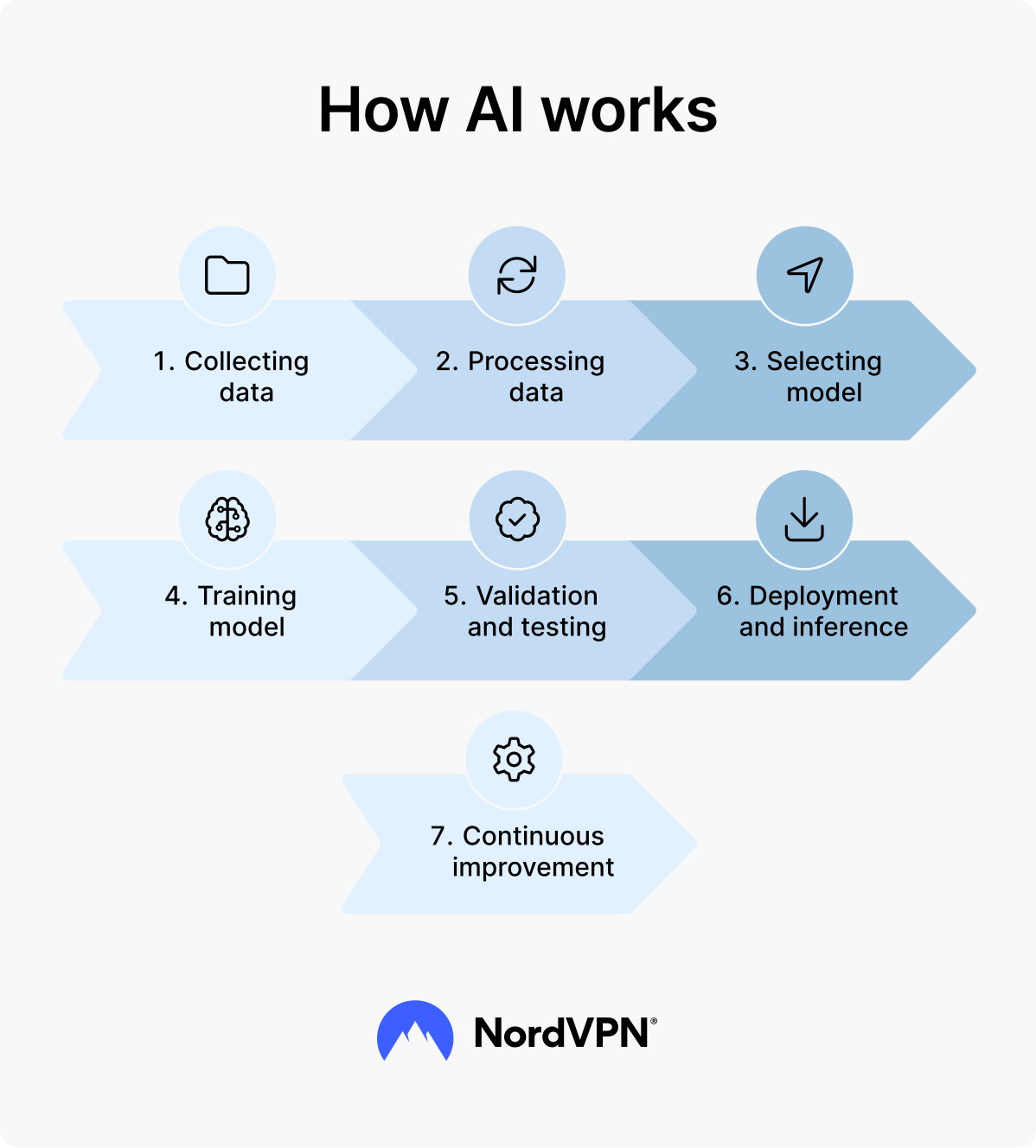
AI transforms raw data into meaningful insights or actions using data analysis, model training, and predictions. This process includes the following steps:
- 1.
Collecting data. AI gathers data from various sources, such as databases, user interactions, or sensors. To get the best results further down the process, raw data has to be high-quality and diverse.
- 2.
Processing data. The raw data is cleaned and organized in preparation for AI analysis. This process includes removing irrelevant information, filling in data gaps, or correcting particular features. The data is then ready for the AI system to use.
- 3.
Selecting model. The engineers choose how the AI model should operate. They typically choose between three options: decision trees for classification, neural networks for pattern recognition, and regression models for predicting outcomes.
- 4.
Training model. AI engineers feed the processed data to the chosen AI model and teach it patterns and correlations. Training also includes adjusting parameters and optimizing performance.
- 5.
Validation and testing. The AI solution is tested with data that wasn’t used during training. This helps measure AI accuracy and see how it performs in unseen scenarios.
- 6.
Deployment and inference. The new AI model is released to make predictions and decisions based on input data.
- 7.
Continuous improvement. The engineers behind the AI model monitor its performance, collect feedback, and retrain the model with updated data. This helps ensure that the AI solution continues to generate accurate results.
What is the purpose of AI?
The main goal of AI is to enhance human efficiency and make it easier for people to perform repetitive or complex data processing tasks. This technological takeover allows people to focus more on innovation, problem-solving, and creative tasks.
However, as AI becomes more accessible, it rapidly transforms how people approach work and even interact with each other. The fact that AI can change the fabric of society raises new concerns about using it ethically. That's why the tech industry introduced a set of principles for creating responsible AI and continuously urges AI developers to follow the AI TRiSM framework to build build trustworthy and secure solutions with AI security in mind.
The benefits of AI
AI aims to help optimize daily operations in people's professional and personal lives, allowing them to get rid of monotonous tasks and give more time and attention to their desired fields. AI’s goal is to:
Help avoid human error
Artificial intelligence can minimize the likelihood of human error in tasks that require high precision, such as data processing, manufacturing, and analytics. AI can operate 24/7 and follow the same automation processes and algorithms without ever losing consistency.
Help automate workflow and processes
AI systems can connect diverse software and tools, streamlining data exchange and eliminating manual intervention. AI is also useful when it comes to scaling because it can handle increased workloads without additional resources.
Take care of repetitive tasks
Companies often use AI to automate various routine tasks, such as data entry, scheduling, or email filtering. This allows businesses and individuals to complete their work faster and focus on more complex tasks that require human interaction and ideas.
Speed up research and development
AI is cutting-edge technology that can deal with massive amounts of data in a short period of time. This helps to reach breakthroughs in various fields faster than ever before. Moreover, AI is able to find patterns and similarities that the human eye can often miss, leading to new explorations.
Operate without disruptions
Technology doesn't need breaks and is not limited by time. This means AI systems can work perpetually until they're stopped.
Help create content
AI-powered tools can help write texts, code, and generate images, videos, and music. This is a valuable feature for generating and improving ideas or drawing inspiration.
The challenges of AI
The AI revolution in tech and other industries came with certain challenges. While AI can improve everyday life, it can also pose serious risks when it falls into malicious hands or is used unethically.
Hackers can use AI to run advanced cyberattacks
Using AI tools, even less knowledgeable hackers can exploit vulnerabilities in targeted systems and run sophisticated large-scale attacks. AI also gave birth to deepfakes, which can be used for malicious purposes, such as mimicking human language or producing fake images to trick users into revealing their sensitive data.
AI can pose a risk to data privacy
Artificial intelligence can collect and process vast amounts of data faster than ever before. However, its effectiveness relies on the data it gathers, often through interactions with users. This raises concerns about the safety of Replika, ChatGPT, as well as ChatGPT Atlas’ trustworthiness, particularly when it comes to learning from human interactions.
Limited or inaccurate information online can result in false input
Due to the lack of context, artificial intelligence might misinterpret data and provide faulty results, known as AI hallucinations. An AI search engine can mitigate this risk by grounding answers in retrieved, citable sources. However, it can still hallucinate if those sources are incomplete or incorrect.
AI tools can sometimes provide biased and unethical responses
If the AI's training data includes unfair or discriminatory information, it can reflect in the AI-generated content. AI models can also struggle with grasping the context and adapting to new scenarios, making their outcomes rigid and lacking common sense.
People may lose their jobs because of AI-powered automation
Artificial intelligence can replace many traditional jobs that rely on manual work. This means people are at risk of losing their occupation and source of income. While reskilling the workforce is the logical solution, it takes time and additional resources.
AI-powered technology consumes a lot of energy and resources
Training advanced AI models requires huge computing resources, which leads to high energy consumption. This raises serious concerns about environmental impact and lack of sustainability.
Protect yourself online
Secure your traffic, boost your privacy, and block cyberthreats.

AI use cases
AI is a versatile technology that can be used for various purposes and in different fields.
AI in healthcare
Artificial intelligence supports diagnostics and can help healthcare professionals detect early signs of diseases through medical image analysis and personalize treatment using predictive analytics. AI-driven research is used to accelerate drug discovery by identifying data patterns and predicting molecular interactions with models like Boltzmann machines that can help optimize molecular design. AI can also help streamline administrative tasks, such as medical record management and patient scheduling.
AI in business
Businesses can try enhancing their marketing strategies using AI personalization tools, while automated predictive analytics can help them better track market trends and manage supply chains. Many companies also use AI-powered intelligent virtual assistants for customer support or to streamline HR processes, such as screening resumes or analyzing employee engagement.
AI in retail
AI technologies power recommendation engines, analyzing consumer activity to develop personalized suggestions. Artificial intelligence can use existing user data to predict consumer behavior patterns. Retail and wholesale companies can use AI to optimize their supply chains.
AI in education
Through adaptive learning platforms, AI can help personalize the learning experience and adjust content based on students' performance. AI-powered language processing tools, such as speech recognition and programs like Voice.AI, can enhance accessibility for students with disabilities. Automating administrative tasks with artificial intelligence can also free up a teacher's schedule, while virtual tutors can provide instant support to students when needed.
AI in finance and banking
Artificial intelligence can be used to analyze transaction patterns and identify suspicious activity, helping to detect fraud efficiently. AI-driven predictive analytics can help banks forecast market trends and make better financial decisions. Meanwhile, AI automation tools can help streamline loan risk assessments, personalize investment strategies, and enhance communication with customers using LLMs (large language models).
AI in law
AI's cutting-edge technology can be used to try to quickly analyze vast amounts of data, including case law and legal documents, which helps streamline legal research. AI's natural language processing can automate contract review and drafting, while predictive analytics can estimate case outcomes.
AI in entertainment and media
Using AI's embedded intelligence, the entertainment industry can personalize recommendations and try to help media companies better understand audience preferences. Tools for emotion recognition and audience behavior tracking help to create more effective marketing strategies. Artificial intelligence is also used to power special effects, automate video editing, and streamline post-production processes.
AI in journalism
Journalism relies on fact-checking and analyzing sources for credibility, which AI can help make more efficient. AI-powered transcription tools can speed up interviews, recommendation algorithms can personalize news feeds for readers, and AI web searches can accelerate journalists' research.
AI in software development and IT
Various AI tools can be used to speed up coding and bug detection, while AIOps enables automation and can streamline operational tasks. Predictive analytics are often used to help maintain systems and optimize their performance. AI-driven chatbots and virtual assistants are becoming essential to providing IT support for users, while intelligent web applications help to develop a better defense against cybercrime.
AI in cybersecurity
Thanks to AI's pattern recognition capabilities, AI tools can be used to detect fraud, prevent phishing attempts, and recognize malicious activity more successfully and efficiently than ever before. While AI-enriched technology is often used to scan networks and identify malware, engineers have also developed an automatic network that can operate by itself with minimal human input. Such mundane tools as face recognition and fingerprint scanning on your phone are other examples of AI use cases in cybersecurity.
Watch the video to learn more about the pros and cons of AI in cybersecurity.
AI in manufacturing
AI can be used to identify equipment failures before they occur, enhance quality control with computer vision, and detect defects in real time. IIoT can help automate repetitive tasks and improve precision and speed on assembly lines, while AI in supply chain management helps forecast demand, optimize inventory, and reduce operational costs.
AI in transportation
With AI-powered technology, the transportation sector can try to better predict traffic congestion, improve route planning, adjust signals according to live conditions, and reduce fuel consumption. Thanks to AI, engineers have been able to develop smart traffic management systems and create self-driving vehicles that can choose faster routes and avoid human errors on the road. Meanwhile, AI's ability to optimize delivery routes and fuel consumption can benefit logistics management.
Want to keep learning?
Subscribe to our newsletter for cybersecurity news and online privacy tips.
The main types of artificial intelligence
Artificial intelligence is typically divided into three main types. However, only one of them currently exists in practice.
Artificial narrow intelligence (ANI)
also known as weak AI, follows pre-programmed rules or learned patterns to perform specific tasks within a limited domain. This type of AI doesn't have true intelligence or understanding of what it's doing and lacks general problem-solving abilities. The most common examples of ANI are chatbots, image recognition tools, recommendation systems, and virtual assistants. It's the only AI that we currently can use.
also called strong AI, is an AI that can think and learn by itself and apply its knowledge across multiple domains. It's an AI similar to human intelligence, which means it can understand and solve problems, adapt to new tasks, and be self-aware and conscious.
Artificial super intelligence (ASI)
is a hypothetical AI system that exceeds human intelligence in all aspects. If ASI ever comes to exist, it will be able to outsmart people in reasoning, problem-solving, decision-making, creativity, and emotional intelligence.
Both AGI and ASI are theoretical concepts that don't yet exist. To bring them to life, engineers would need to find a way to fully replicate human consciousness and reasoning or, in the case of ASI, even surpass it. This calls for significant advancements in computing, neuroscience, and machine learning. The possibility of AGI and ASI also causes ethical concerns because AI that matches or surpasses human intelligence can become unpredictable and uncontrollable.
AI training models and applications
AI training models are the foundation of artificial intelligence. They learn from data to perform specific tasks and perpetually improve as they process more information. The quality and diversity of this data play a huge role in how effective AI applications can be.
AI learns in different ways, depending on the problem it's trying to solve. The three main types of training models are:
Supervised learning. AI learns from labeled datasets — think of it like studying with an answer key. The system is shown examples with the correct answers. It then tries to predict outcomes on new, similar data. This approach is common in tasks like image recognition and spam detection.
Unsupervised learning. Here, AI identifies patterns and relationships in data without predefined labels. This method is used in customer segmentation, anomaly detection, and recommendation systems.
Reinforcement learning.. Think of reinforcement learning as learning through trial and error. AI makes decisions, receives feedback in the form of rewards or penalties, and adjusts its strategy to maximize success. This is how AI systems master games like chess, control robots, and manage unpredictable environments like traffic systems.
The main subsets of AI
Artificial intelligence can be divided into a number of subsets, each focusing on specific aspects of intelligence and problem-solving. Examples include but are not limited to:
Machine learning (ML)
Machine learning (ML) allows computers to solve problems or make decisions by identifying patterns in data. These systems learn from data rather than explicit programming and often use a backpropagation method to adjust internal parameters and improve accuracy. As a result, machines built with ML can make predictions or decisions that haven't been programmed.
Systems enriched with machine learning can process large amounts of data and improve accuracy over time. Sadly, cybercriminals have realized ML’s potential as effectively as cybersecurity enthusiasts. That's why engineers have invented techniques, such as adversarial machine learning, to prevent the misuse of machine learning algorithms.
Machine learning is itself a broad discipline with various subsets. Some noteworthy subtypes of ML include AI models built on neural network architectures, such as artificial neural networks (ANNs) and deep learning networks (DNNs).
ANN aims to replicate the structure and function of the human brain. These networks are designed to recognize patterns, process complex data, and make decisions by simulating the way biological neurons work.
Deep learning refers to artificial neural networks with multiple hidden layers. Because of that, DNNs can capture intricate patterns and identify specific aspects in vast amounts of data. With more layers and connections, deep learning models have significantly more trainable parameters.
Natural language processing (NLP)
NLP enables machines to understand, interpret, and generate human language. This AI subset combines linguistics, computer science, and machine learning to analyze large amounts of natural language data so it can later power chatbots, translation services, and voice assistants.
Expert systems
Expert systems imitate human intelligence by applying logical rules to given facts so they can draw conclusions or solve complex problems. An expert system usually consists of two subsystems: the knowledge base and the inference engine. The knowledge base represents facts and rules, while the inference engine uses the given rules to deduce new facts.
Genetic algorithms (GAs)
Inspired by natural selection and genetics in biology, genetic algorithms (GAs) can solve complex problems by imitating evolutionary processes. The algorithm works by considering several possible solutions, overseeing how they would evolve over time, and choosing the best or most optimal solution based on the results. As an evolutionary computation method, GAs are widely used for solving optimization problems where the search space is large or poorly understood.
Other noteworthy AI subsets are:
| Subset | Key features |
|---|---|
| Generates new content, such as text, images, videos, music, and code. | |
| Simulates human-like interactions using text or speech. | |
| Makes decisions, adapts to new situations, and performs tasks independently, without human intervention. | |
| Simulates human cognitive functions such as learning, reasoning, problem-solving, perception, and decision-making. | |
| Autonomously and continuously interacts with its surroundings to process information and take action. |
Augmented intelligence vs. artificial intelligence
The distinction between artificial intelligence and augmented intelligence is growing. Augmented intelligence refers to AI systems we have today — designed to enhance human intelligence rather than replace it altogether. These systems may help people make better decisions, work more efficiently, and handle complex data faster than they could on their own. Augmented intelligence acts more as a smart assistant than an autonomous system.
Although we often use “artificial intelligence” as an umbrella term, in this framework, it refers to systems that aim for autonomy, including the concept of artificial general intelligence (AGI). AGI would be capable of human-like reasoning across any task, potentially leading to the so-called technological singularity — a hypothetical future where AI surpasses human intelligence.
Jobs and careers in artificial intelligence
AI isn’t just reshaping various industries. The emergence of artificial intelligence has created an entirely new job market. As AI and machine learning continue to expand, the demand for skilled professionals grows rapidly. In-demand careers in the field of AI include:
Machine learning engineers
They design and build models that learn from data, improving their performance without human intervention.
Data scientists
They analyze complex datasets to uncover patterns, generate insights, and build predictive models.
AI research scientists
They develop new algorithms, explore advanced machine learning techniques, and drive innovation in the field.
AI ethics specialists
As AI's influence grows, so do ethical challenges. These professionals ensure AI technologies are fair, unbiased, and transparent, tackling issues like data privacy, algorithmic bias, and responsible AI governance.
Natural language processing engineers
They develop AI systems that understand and generate human language, powering technologies like voice assistants, chatbots, and real-time translation tools.
Computer vision engineers
They teach machines to interpret and process visual data from images and videos. Their work is critical in facial recognition, autonomous vehicles, and medical imaging.
Breaking into the field of AI often requires a strong foundation in data science, computer science, or related areas. Although many roles prefer candidates with advanced degrees in AI-adjacent fields, having practical skills in programming — Python is a must — and machine learning frameworks, as well as experience with data analysis, can be just as valuable.
What does the future hold for artificial intelligence?
AI techniques are evolving faster than most technologies we've seen before. While it's hard to predict exactly where this is headed, a few trends have already begun shaping the future of AI.
Smarter AI-human collaboration
Expect AI to handle the repetitive stuff, freeing humans to focus on creativity, critical thinking, and problem-solving.
A stronger focus on AI ethics
As AI becomes more influential, questions around bias, fairness, and accountability will take center stage. The push for transparent, ethical AI systems, including generative AI, is becoming an integral part of AI development.
Advancements in general AI
Although today's AI is great at specific tasks, the race toward systems that can think and learn across a wide range of activities is ongoing.
Greater AI integration
From personalized healthcare to smart cities, AI is expected to become woven into our daily lives. Some experts think it might become a seamless part of the infrastructure we rely on.
Frequently asked questions
Online security starts with a click.
Stay safe with the world’s leading VPN