What is WAN?
A WAN is a collection of smaller local area networks (LAN) linked together for a specific purpose. In effect, it is a network of networks that spans across multiple locations. WANs have no upper size limit, ranging from simple enterprise connections between two branch offices all the way to the biggest, most complex network of all — the internet.
WAN vs LAN: What’s the difference?
The main difference between WANs and LANs is their scope. A LAN connects devices in a single area, be it an office building, a college campus, or even a single household. By contrast, a WAN connects multiple LANs together, letting devices in different networks talk to each other.
Imagine you want to upload a picture from your laptop to your cloud storage. Your laptop is connected to your home network, which is a LAN. The cloud provider’s servers span multiple data centers, each with its own network. These separate networks communicate over the internet — a global WAN — which acts as a medium for data transmissions.
How does a WAN work?
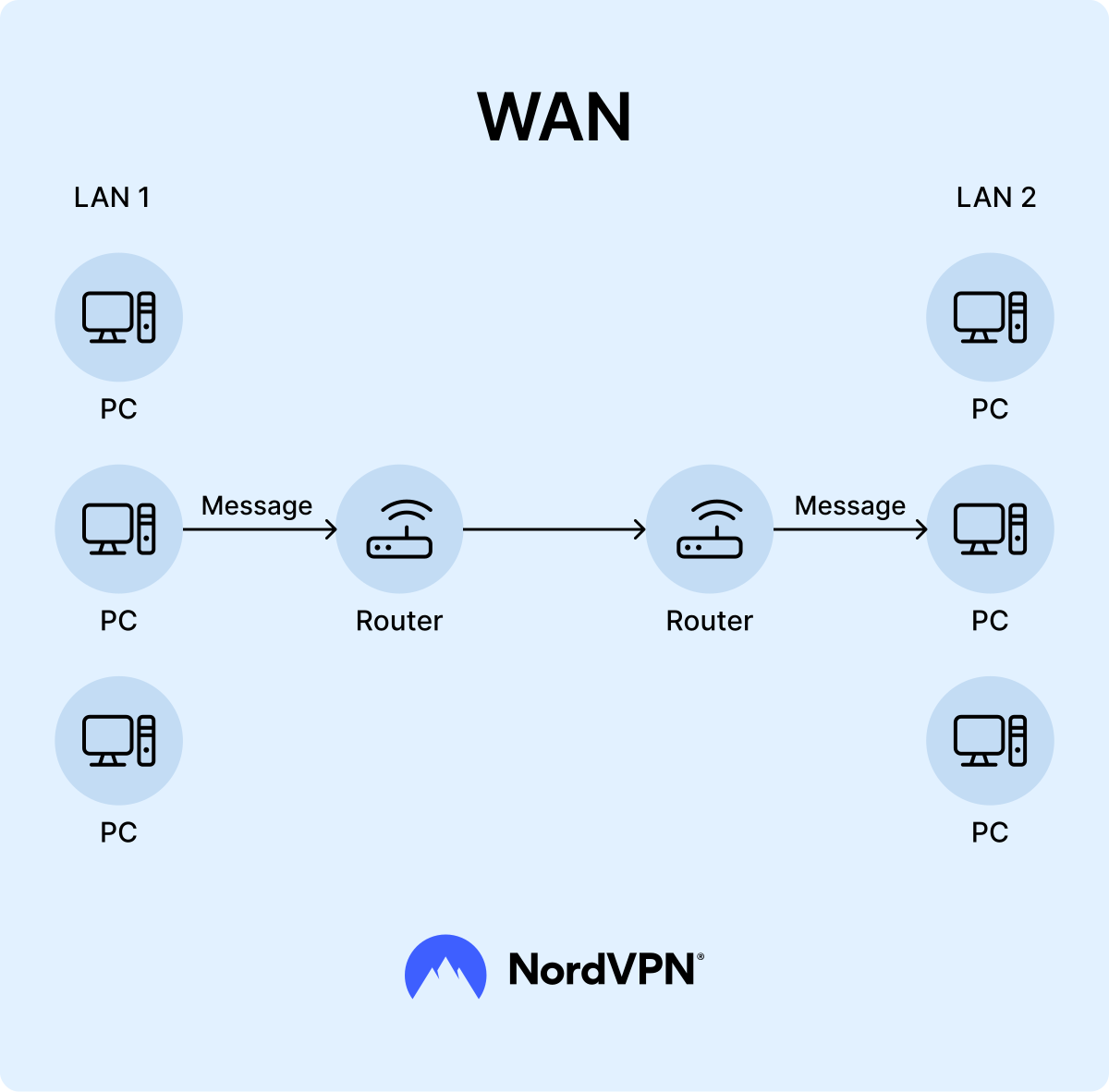
A WAN works by relaying messages between multiple connected LANs.
- 1.
To connect a LAN to the WAN, you need a gateway — typically a router. This gateway makes outgoing data suitable for transmission using WAN protocols and indicates where it needs to go.
- 2.
The WAN carries the package to another gateway, one leading to the LAN with the receiving device. The data may travel through a variety of network types, including both public infrastructure (like the internet) and private leased lines.
- 3.
The WAN carries the package to another gateway, one leading to the LAN with the receiving device. This gateway unpacks the data and delivers it to the recipient.
What is the purpose of a WAN?
The purpose of WANs is to let devices belonging to different networks talk to each other. While this sounds simple, keep in mind that these networks may be miles or even continents apart — as such, WANs are the cornerstone of global telecommunications.
Public WANs like the internet are used by billions of people every day to communicate and access online services. WAN infrastructure is what allows you to browse (accessing servers hosting the website content), use online banking (connecting to the bank’s network and services), and enjoy social media (connecting to the platform).
At the same time, multinational organizations can set up private WANs to connect their offices together, letting employees in different countries access the same systems, share files, and collaborate day to day. Educational institutions can use private WANs to provide easy access to online learning and share research among the staff located in different campuses.
Where are WANs typically used?
WANs are used the most in the following areas:
Telecommunications
As we’ve discussed, the internet is a large public WAN connecting millions of LANs together. These LANs range from small home networks to public-facing government offices.
Government and military networks
Both government departments and military headquarters use secure private WANs to connect with sensitive installations, such as overseas military bases.
Enterprise networks
Businesses, retail chains, and franchises use private WANs to connect regional offices together, letting employees in different parts of the world access the same resources for work purposes.
Education
Schools and universities can set up a WAN to cover the whole of the campus grounds or even multiple campuses spread across the region. These WANs are used both for research (such as sharing data between professors) and administration.
Private healthcare
Healthcare companies operating multiple hospitals or research labs often use private WANs to share confidential patient information and research data.
Protect yourself online
Secure your traffic, boost your privacy, and block cyberthreats.

The most common types of WAN protocols and technologies
The transmission of information across a WAN is governed by WAN protocols — standardized rules for formatting, packaging, and relaying data. These protocols rely on WAN technologies to work, which make up the physical and logical infrastructure of the network itself.
Types of WAN protocols
“WAN protocol” is an umbrella term covering any protocol used in transmissions over a WAN to distant LANs. The WAN protocol suite includes:
PPP (Point-to-Point Protocol) is a data link layer (Layer 2 in the standard OSI model) protocol that connects a pair of routers directly. PPP was a reliable option for secure communication across simple WAN links, but the protocol has largely been replaced by Ethernet technology today.
High-Level Data Link Control (HDLC) is another Layer 2 protocol that was used for reliable data transmission in point-to-point and multi-point communications in the past. Like PPP, HLDC has been superseded by Ethernet technology.
IP (Internet Protocol) is the quintessential WAN protocol — after all, the internet itself is a WAN. Each router has a WAN IP address (also known as a public IP address) to help other networks find it over the WAN it is connected to. IP is a layer 3 protocol according to the OSI model.
Border Gateway Protocol (BGP) manages packet routing across the internet through the exchange of routing and reachability information among edge routers. BGP is often used by autonomous systems — collections of IP networks and routers controlled by a single entity. BGP operates on layer 7 of the OSI model.
Open Shortest Path First (OSPF) is another layer 7 protocol that lets routers build network topology maps to identify the shortest path for data.
Intermediate System-to-Intermediate System (IS-IS) helps routers swap information to determine the most efficient path across the network.
Types of WAN technologies
The following technologies are commonly found in WAN setups.
Ethernet is a family of technologies and protocols that underpin the majority of the internet we use today. Ethernet operates under the IEEE 802.3 standard (or the Ethernet standard), specifications that were created by the Institute of Electrical and Electronics Engineers (IEEE) in the 1980s. Ethernet has continued to evolve over the years — while the first version only managed speeds of 10Mbps, some commonly used types can now reach speeds of around 40Gbps.
Software-defined networking technologies are the backbone of SD-WANs (software-defined WANs), which don’t rely on specialized hardware to control network traffic. The ability to set up networks without investing into extensive physical infrastructure has made SD-WANs the most popular WAN solution.
Broadband internet is the umbrella term for networking technologies for wide-bandwidth data transfers for a fast internet connection. Broadband is one of the main ways to access public WANs, including the internet — without it, many activities, such as streaming video or holding online conference calls, would simply be untenable for most people. While most broadband connections are shared between multiple users, some organizations lease their own dedicated lines (a practice known as Direct Internet Access, DIA).
MPLS (Multiprotocol Label Switching) is used by organizations that rely on high-performance connections between multiple locations. It directs data from one node to the next based on short path labels rather than long network addresses.
Frame Relay used to be a popular WAN technology in the ’90s, but it has largely been replaced by MPLS and Ethernet today. Frame Relay would encapsulate data into frames and transmit them using virtual circuits over packet-switched networks.
ATM (Asynchronous Transfer Mode) organizes data into small, fixed-size packets called cells, allowing for very fast switching. This made ATM ideal for voice and video traffic in the early days of the internet, but it has largely fallen to the wayside as Ethernet networks became faster.
What is WAN architecture?
WAN architecture describes the overall shape of the network — how the LANs making up the WAN are connected to each other. WAN architecture covers the technologies used, data flow arrangements, connection points, and network security measures.
The key architectural components of a WAN are:
Customer premises equipment (CPE)
CPE refers to networking devices that (just as the name implies) are situated on the customer’s premises. These devices serve to separate the LAN from the WAN, translating the addresses between them and using firewalls to keep intruders out.
Edge appliances
Any software or hardware straddling the line between a LAN and the WAN routers is an edge appliance. For home and small office networks, these devices also double up as CPE — only larger organizations keep edge appliances off their premises. The most prominent edge appliance is the router, which connects LANs and WANs together, but this category also covers firewalls and SD-WAN appliances guarding access points into the LAN.
Connecting media
WANs require physical infrastructure to reach LANs in remote locations. For example, a company wishing to set up a private WAN may need to install underground fiber optic cables between sites or build cellular towers to cover an area in 5G signal.
Protocols
WAN protocols dictate how data is prioritized, transmitted, and secured over the network.
Want to keep learning?
Subscribe to our newsletter for cybersecurity news and online privacy tips.
Types of WAN connections
The term “WAN connection” refers to the infrastructure linking the LANs together, including both physical media and logical protocols. The three main types of WAN connection are wired, wireless, and hybrid.
Wired WANs use a spiderweb of physical cables to connect LANs together. They can be simple and quick to deploy if you take advantage of existing infrastructure — but become very complex very quickly if you need to build the network from the ground up. Leased lines (infrastructure rented from the ISP for the sole use of a single organization) are some of the most common wired WAN connections.
Wireless WAN (WWAN) technologies let users form wireless networks of truly impressive scale — where a wireless local area network (WLAN) may cover a building, a WWAN could keep a district or even an entire city connected. WWANs often use cellular network technologies (such as 5G) for data transmission.
Hybrid WANs combine both wired and wireless connections. These WANs often integrate both public and private infrastructure into a single network. The best example of a hybrid WAN is the internet — while cities enjoy broadband cables, less developed rural areas may have to rely on cellular networks or satellite coverage for internet access.
What are the pros and cons of WAN connection types?
Each WAN connection type comes with its own advantages and disadvantages. The following comparison table helps you see the main differences between wired, wireless, and hybrid WANs.
| | Wired | Wireless | Hybrid |
|---|---|---|---|
| Relies on existing infrastructure | | | |
| Easy to set up in less developed areas | | | |
| Easy to scale | | | |
| High connection speed | | | |
Frequently asked questions
Online security starts with a click.
Stay safe with the world’s leading VPN