AI vs. machine learning vs. deep learning: The AI hierarchy
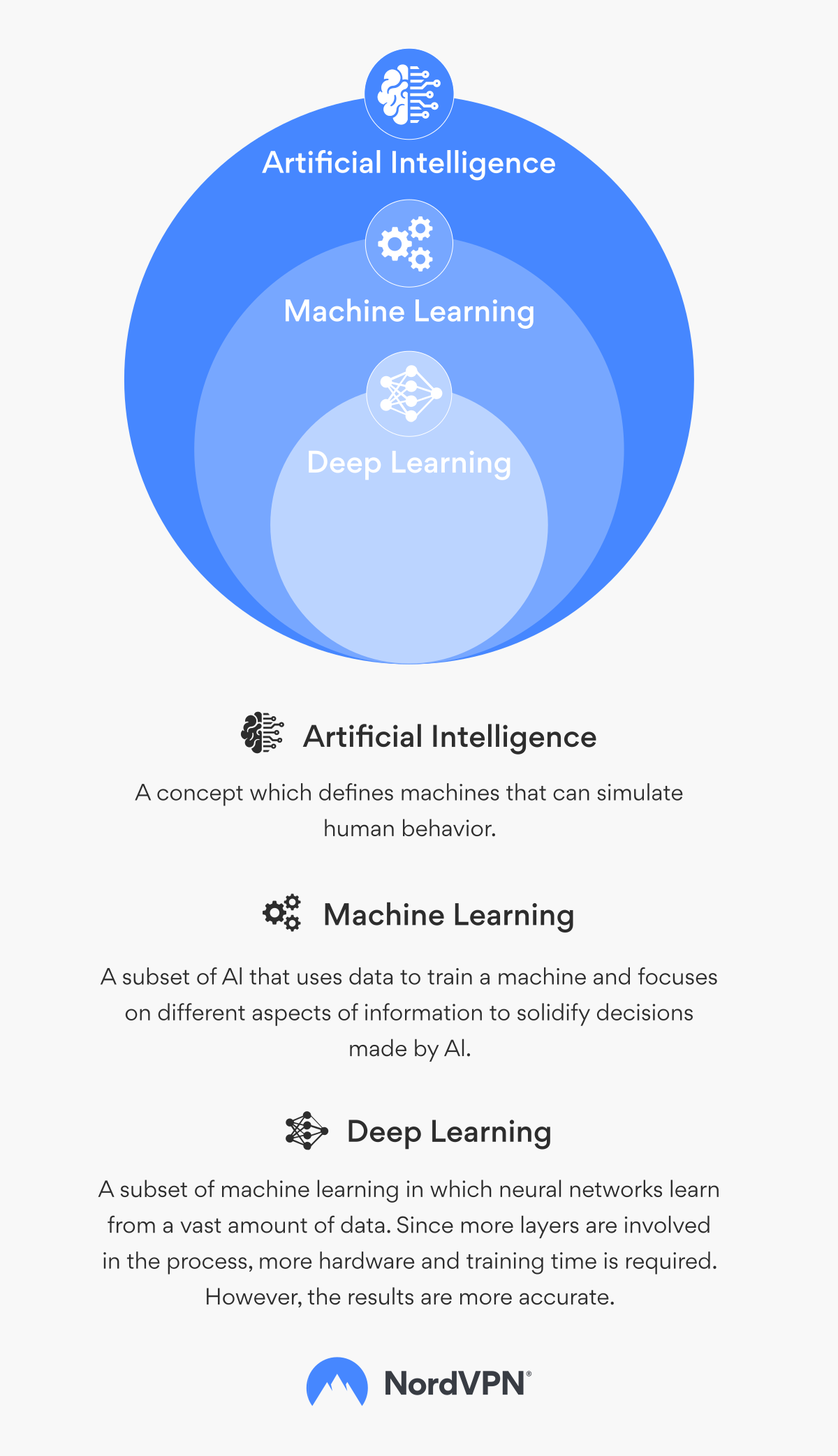
Picture artificial intelligence (AI) as the top layer of a pyramid, with machine learning (ML) and deep learning (DL) as sublayers underneath it. When you hear someone talk about AI, they’re usually describing a computer system that tries to mimic something humans do: make predictions, recognize patterns, or understand language. Machine learning is one way to achieve that goal. Deep learning is a more specialized way to achieve the same goal using many-layered neural networks, which are computational structures inspired (more or less) by how biological neurons process signals.
This hierarchy actually carries some weight because people do use these terms interchangeably. So when someone says "AI detected fraudulent activity on my account," the actual worker driving that detection is usually a machine learning model and not a full-blown AI system. And when someone says “AI understood my voice command,” the person is almost certainly pointing to a deep learning model built to recognize speech.
So try to remember AI as the broad concept, machine learning as a specific method inside that concept, and deep learning as a more advanced method inside machine learning.
What is artificial intelligence?
Artificial intelligence is a field of computer science that focuses on building systems capable of performing tasks that normally require human intelligence. This includes understanding language, recognizing images, solving problems, and making predictions. And AI isn't one single technology but an umbrella term for many different methods.
For example, when a navigation app suggests a faster route, an AI system is analyzing live traffic and historical patterns to calculate the best path. That AI system might rely on machine learning models, deep learning models, or even older rule-based systems. If the technology helps a machine behave more intelligently, it fits somewhere under the AI label.
What is machine learning?
Machine learning is a branch of AI where engineers teach computers to learn from data instead of giving them a long list of preset rules. In practical terms, an engineer gives a model examples — say, a few hundred thousand entries of customer behavior — and the model looks for patterns that help it make predictions about new data.
Machine learning takes different forms depending on how the engineer constructs the task:
- Supervised learning. The engineer feeds the model labeled data. For example, they might train it on emails identified as “spam” or “not spam.” The model studies these examples to learn how to sort new emails.
- Unsupervised learning. The engineer gives the model unlabeled data, and the model groups things based on similarities. This type of learning is used for customer segmentation or anomaly detection.
- Reinforcement learning. The model learns by trial and error. It receives feedback, positive or negative, as it interacts with an environment. It's the technique most used to train models to excel at strategy games and other rule-based environments.
As different as they are, these forms all work off the same fundamental idea: The model learns from the data, but engineers still decide which key inputs (features) will be used to guide how the model makes decisions. And in practice, many teams complement this workflow by applying data mining techniques to surface patterns worth feeding into the model before training even begins.
What is deep learning?
Deep learning is a subset of machine learning that uses multi-layered neural networks to learn directly from raw data. Each layer of the network extracts increasingly complex features, which means the engineer doesn’t need to manually specify what the model should pay attention to.
A deep learning model works especially well when someone gives it large volumes of unstructured data (it can be images, audio, or text) because the network automatically discovers the underlying patterns.
Deep learning also comes in several forms:
- Convolutional neural networks (CNNs). These are built for image and video tasks. A CNN might identify edges, shapes, and textures in the early layers and full objects (like “cat” or “car”) in later layers.
- Recurrent neural networks (RNNs) and long short-term memory networks (LSTMs). These models process sequences, such as sentences or time-series data, by “remembering” what came before.
- Transformers. Modern tools like large language models (LLMs) rely on transformers because they can analyze text in parallel and capture long-range dependencies. These models also power many modern examples of generative AI, including tools that create text, images, or audio based on patterns learned from huge datasets.
If traditional machine learning is like giving a computer a well-curated toolbox, then deep learning is like giving the computer a machine that builds its own tools as it learns.
How machine learning and deep learning work
Both machine learning and deep learning are data driven, but they diverge in how they learn. Machine learning leans more on human input to shape how the model understands the data, whereas deep learning hands much of that responsibility over to the model itself.
How machine learning learns from data
When someone builds a machine learning model, the engineer typically begins by choosing the right features. A feature is an input variable that helps the model make a prediction. For example, if a bank wants to predict loan repayment, an engineer might choose features like age, income, credit history, and employment stability. This step called “feature engineering” plays a major role in how well the model performs.
Once the engineer defines the features, the next step is model training. During model training, the model studies historical data and adjusts its internal parameters until it finds patterns that allow it to make accurate predictions on new, unseen data.
This approach works well when engineers training the model understand the domain and can identify meaningful inputs. It also makes the model easier to interpret because then the people working on it can understand how each feature contributes to the final prediction.
How deep learning learns differently
Deep learning removes much of the human involvement in feature engineering. So instead of telling the model what to look at, the engineer gives it raw data, which can include thousands of images, hours of audio, or millions of sentences, and the network figures out which patterns matter the most.
Each layer of a deep neural network transforms the data. Early layers might detect simple shapes, mid-level layers might detect object parts, and deeper layers might detect full objects. This process of automatic feature extraction is what allows deep learning systems to handle such complex and messy data, and it’s the same process that drives modern image recognition.
The trade-off is that deep learning requires far more data and computing power. But when the conditions are right, deep learning models can outperform traditional models and do so by a wide margin, especially in tasks where patterns are too complex for humans to describe manually.
Key differences between deep learning and machine learning
Machine learning and deep learning solve similar problems, but they do so in very different ways. This comparison table gives you a quick overview before we break each point down further.
| Category | Machine learning | Deep learning |
|---|---|---|
| Feature extraction | Human engineers select features. | Neural networks automatically extract features. |
| Model complexity | Uses simpler models (decision trees or logistic regression). | Uses complex multi-layered neural networks. |
| Data needs | Works well with smaller, structured datasets. | Needs large, diverse datasets to perform well. |
| Interpretability | Easier to interpret and explain. | Harder to interpret, so it can become a “black box.” |
| Compute requirements | Lower compute needs, trains faster. | High compute needs and long training times. |
| Scalability | Scales moderately with more data. | Performance improves dramatically with large-scale data. |
Feature engineering and data processing
Machine learning requires the engineer to select which features are important. That human input shapes how the model learns. If an engineer picks poor features, the model struggles. Deep learning alleviates a significant portion of that responsibility by identifying features autonomously, but this independence comes at the expense of substantial data requirements. A deep learning model won’t learn well from small datasets because the network requires a huge amount of variation to understand complex patterns.
Model complexity and architecture
Many machine learning models are built from relatively simple components. For example, linear regression and decision trees rely on straightforward mathematical structures. Gradient-boosted models combine many simple decision trees into a more complex ensemble.
In contrast, deep learning uses neural networks with dozens, sometimes hundreds, of layers. And these networks can learn highly complex patterns, but the complexity also makes them harder to infer. A lot of times when a deep learning model makes a decision, it’s difficult for an engineer to answer the question “why did it do that?” in a way that satisfies regulators or stakeholders.
Data requirements and scalability
When data is small and neatly structured (think spreadsheets, tabular data, or clean log files), traditional machine learning usually performs best. Deep learning is more effective and thrives in the opposite environment, handling enormous, messy datasets such as images or speech samples. Deep learning models also scale better because performance normally improves as more data becomes available, and machine learning can hit a ceiling where adding data doesn’t dramatically improve accuracy.
Interpretability and transparency
Machine learning models are typically easier to interpret. An analyst can look at feature weights or decision paths and explain how the model arrived at its prediction. Deep learning models are much harder to interpret because their decision-making is distributed across many layers, each performing abstract transformations. That lack of transparency is a valid concern in areas like healthcare or finance where stakeholders need to understand how a decision came to be.
Compute needs and training time
Training machine learning models requires modest hardware and relatively short training cycles, while deep learning usually demands specialized hardware (GPUs or TPUs) and significantly more time to train. This difference has a real operational impact when organizations require rapid iteration or frequent model updates. A deep learning project might take days or weeks to train properly, and that cost scales with model size.
Machine learning vs. deep learning use cases
Both ML and DL are used in everyday applications but each technology is suited to different tasks based on the structure of the data and the complexity of the problem.
When machine learning makes sense
Machine learning performs well when a problem uses structured data and doesn’t require deep contextual understanding. Think of examples such as:
- Churn prediction. A company might use customer profiles, subscription history, and past behavior to predict who is likely to leave. Machine learning models handle these structured inputs very well.
- Fraud detection. Banks often rely on ML models to identify unusual spending patterns. The model compares new transactions to a customer’s historical behavior and flags any transaction that falls outside the customer’s usual behavior. Machine learning also helps companies with phishing detection because the model can analyze email metadata, language patterns, and sender behavior to spot suspicious messages.
- Credit scoring. Financial institutions use ML to determine how likely someone is to repay a loan. These models benefit from clear, interpretable rules.
So if you break these tasks down, you notice they don’t require the model to understand visuals or language but instead rely on clear numerical or categorical inputs, which is where machine learning is best suited.
When deep learning is the better choice
Deep learning is the better choice when a system has to learn from complex, high-volume data that traditional models struggle to capture or represent reliably.
- Image recognition. Let’s take healthcare as an example of how deep learning applies to image recognition. Healthcare providers may use deep learning models to identify tumors in medical scans because neural networks are able to detect pixel-level patterns that aren’t always identifiable by the human eye.
- Natural language processing. Most systems that handle written or spoken language, including translation models, chatbot apps, and voice assistants, use deep learning to capture the structure and meaning of text. That is because a deep learning model doesn’t need someone to define grammar rules ahead of time. It discovers those rules by analyzing huge collections of sentences, which helps the model understand context more or less the same way a person does.
- Voice transcription. Deep learning models train on thousands of hours of recorded speech, learning patterns in pacing, emphasis, and natural pauses. And that’s why, for speech recognition systems that turn audio into written text, deep learning is the better choice.
Unlike the earlier examples that rely on numerical or categorical inputs, these tasks deal with raw data — exactly the kind deep learning is designed to learn from. And that is what makes it more effective, and typically the better choice, in these domains.
Choosing between ML and DL
It's easy to fall into the trap of thinking that one must always be better than the other whenever you compare two things. And that’s especially true with deep learning and machine learning. If you're choosing between the two, your practical constraints and project goals should be the real drivers of your decision. So now let’s look at the situations where each one makes the most sense.
Data volume and data type
Deep learning models need large, unstructured datasets to reach high accuracy. If someone only has a few thousand rows of structured data, machine learning will almost always perform better. Now if someone has millions of images or text samples, deep learning becomes the more suitable option.
Need for model explainability
Some teams, particularly those in the industries of finance, insurance, or healthcare, need to explain every prediction their models make. Traditional machine learning offers that clarity, while deep learning generally does not because its models are more complex and opaque. If interpretability is non-negotiable, machine learning will usually be the better choice.
Budget and compute availability
Deep learning is resource intensive. Training large models requires GPU clusters or substantial cloud computing, which can become expensive. Machine learning models typically run on standard hardware, making them considerably more cost-efficient for most organizations.
Project timeline and complexity
Machine learning projects typically progress quickly since the models are simpler and allow for rapid iteration. Deep learning projects take longer because the models need more data cleaning, more tuning, and more experimentation. So if someone needs results within weeks, ML is usually the more realistic option.
Team expertise required
Deep learning projects require specialists who understand neural architectures, GPU optimization, and frameworks like TensorFlow or PyTorch. Machine learning projects can be handled by generalist data scientists who understand statistics and model evaluation.
Cost to train and deploy
Deep learning models cost more to train because they run on specialized hardware and require longer training cycles. Deployment costs can also be higher because the model may run slowly without proper optimization. Machine learning models are lighter, cheaper, and easier to deploy for most business applications.
Environmental impact
Deep learning models consume significantly more energy during training. Large-scale models can require weeks of GPU time, which drives up energy usage and increases their carbon footprint. Teams with sustainability goals may prefer machine learning when both approaches deliver comparable results.
Online security starts with a click.
Stay safe with the world’s leading VPN